Has Nutrition Been Lost in the Shift to Food Systems?

I was having a lovely catch-up with my good friend and colleague Stineke Oenema, the former Executive Secretary of UN Nutrition, and we were discussing the current “positioning” of nutrition. Nutrition has always been important. The problem is that it rarely stays at the center of global development attention for long.

For decades, the international agenda has moved in waves. In the mid-20th century, the priority was food security: preventing famine, increasing yields, and making sure countries had enough to eat. Later, nutrition emerged more explicitly as a development goal in its own right. The first 1,000 days framework helped focus attention on a critical period in child development. The Scaling Up Nutrition (SUN) Movement created a political platform (RIP David Nabarro). Nutrition-sensitive agriculture pushed the idea that farming should do more than produce calories — it should improve diets.

Now the dominant frame is food systems. That shift has brought real value. It has helped connect production, trade, diets, health, climate, and resilience. It has broadened the conversation in useful ways that take on the holistic nature of food as an interconnected system that should not be dealt with as isolated activities without consequences. But it also raises an uncomfortable question: when nutrition is absorbed into a bigger agenda, does it gain strength — or lose visibility?

That question matters because nutrition has never been a narrow technical issue. It is multi-causal and deeply political. It depends on food, yes, but also on health services, clean water, sanitation, education, income, social protection, and care. No single ministry or institution can fix it alone. That complexity makes nutrition harder to govern than many other development priorities. It is everyone’s concern, which too often means it becomes no one’s responsibility.

And yet the case for nutrition has never been stronger. Every country in the world faces some form of malnutrition. In some places the challenge is undernutrition and stunting. In others it is micronutrient deficiencies. Elsewhere it is overweight, obesity, and diet-related disease. Often, all of these coexist. Malnutrition is not just a problem of the past—it is a defining feature of the present.

It is not all terrible. In the just-released State of Food Insecurity Report, also known as “the SOFI,” produced annually by FAO et al, they show that global progress on reducing stunting, wasting, and overweight among children under five years of age is improving, but “marginally.” Yet, the data suggests that child stunting has declined substantially in Africa. The region is also on track to achieve the child overweight and wasting targets, with projections indicating that both targets will be surpassed by 2030. Asia is on track to meet the 2030 goal for stunting (which is a 40 percent reduction in the number of children under five years of age who are stunted). That is incredible!

However, not all is quiet on the western front either. Progress on reducing undernutrition is mixed when looking at regions, countries, and within pockets of countries, and meeting the 2030 targets shows there is still a lot of work to do (look at all that red in the SOFI graphic below). Some countries are really struggling. Anemia among women is getting much worse. We worked on a Lancet Hematology Commission this past year to draw more attention to anemia, which has devastating consequences for women. Obesity among adults continues to increase, but perhaps the GLP-1 drugs may halt some of this rise, eventually (that is, if they become widely available, cheap, and don’t cause known/unknown harms).
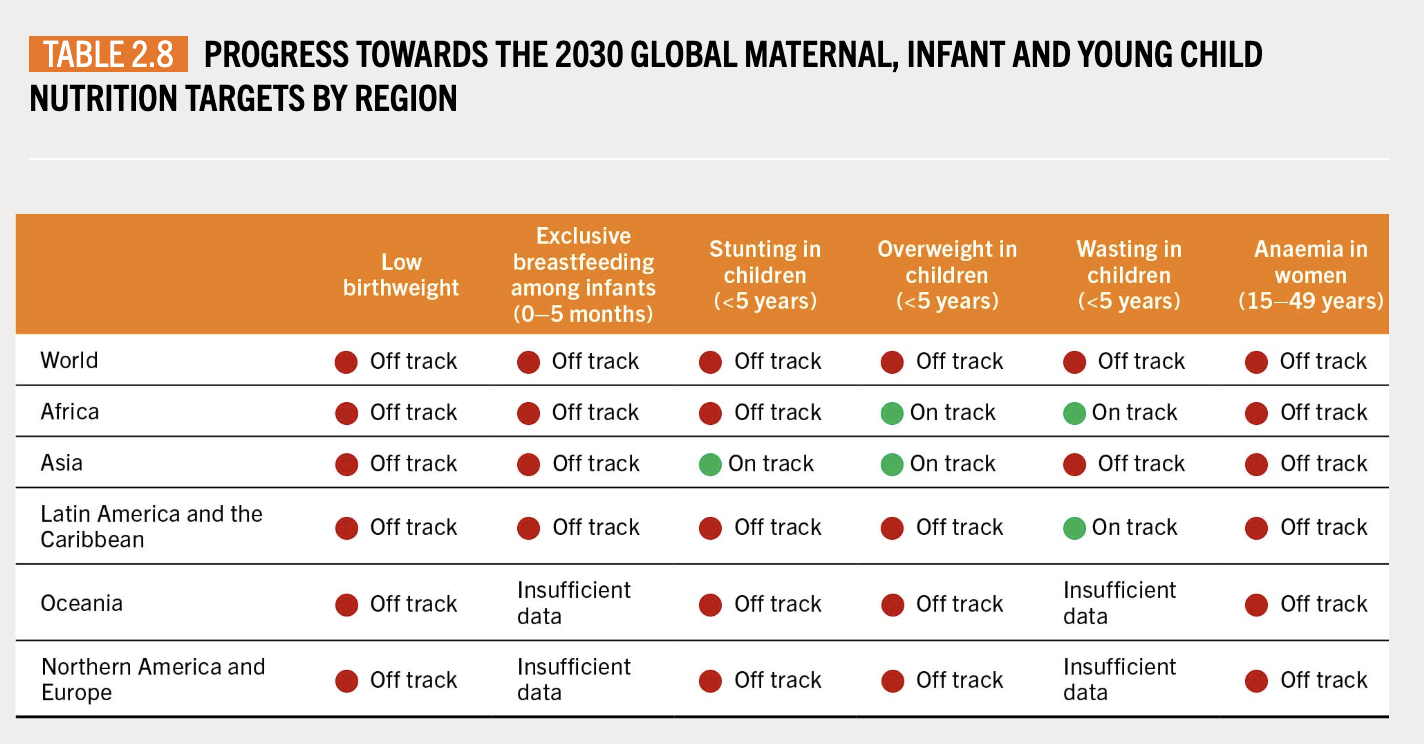
Analysis from SOFI 2026 report (FAO)

The stakes are rising. Conflict, climate change, inflation, tariffs, and geopolitical shocks all affect food prices and food access. When prices rise, households do not simply buy less food — they often buy less nutritious food. Diet diversity declines. Women and children are often hit first and hardest. In other words, shocks to food systems, and many other systems, are also shocks to nutrition. This is why nutrition cannot be treated as a sub-theme within broader debates on food, climate, or geopolitics. It sits at the intersection of all three.

The danger today is not that nutrition has disappeared from the agenda. It is that it is being folded into other priorities without enough explicit attention of its own. Food systems are important, but food systems do not automatically produce healthy diets. A system can be efficient, resilient, and climate-smart and still fail to improve nutrition. Unless nutrition is named, measured, financed, and held accountable, it can easily be assumed rather than delivered.

That is the lesson from nutrition’s history. The issue gains ground when it is attached to a larger political narrative — but it only stays visible when it remains a distinct objective. The 1000 days agenda worked because it was specific. SUN worked because it created a coalition and a sense of urgency. While SUN has brought countries together around nutrition, participation has not become universal and countries committing to SUN appears to have slowed. Nutrition-sensitive agriculture mattered because it tried to make nutrition everyone’s business. But each time the field broadened, the risk of dilution grew too.

Maybe we nutritionists aren’t needed anymore – undernutrition is slowly coming down, and now, GLP-1s are the “saviors” of the obesity pandemic…I think you all know I am being a bit sarcastic here, but truly, what is next? Will another report or a global meeting that focuses solely on nutrition help? Likely not. Even more so, is international development dead? I really hope not…but it ain’t lookin’ so good for 2030 if things stay as they are.

So, what comes next? Right now, with the current world order, I have no clue, my friends. Perhaps it is One Health. Perhaps it is climate-nutrition links. Perhaps it is a stronger focus on resilient diets, commercial determinants of health, or the health consequences of food environments. Maybe it’s everything, everywhere, all at once. Whatever the next frame is, it should not replace nutrition. It should protect it.

Because nutrition is not a luxury issue to be revisited when the world has time. It is foundational to human development, resilience, and equity. If the world is serious (which is questionable at the moment) about reducing poverty, improving health, strengthening food security, and building climate resilience, then nutrition must remain visible — not just as part of the conversation, but as a priority in its own right.

The next global agenda post 2030 should not have to rediscover nutrition all over again. It should learn how to keep it there. 

Nutrition and Agriculture Research: Some Thoughts

I recently was asked to provide some commentary at the International Food Policy Research Institute (IFPRI) at the ARENA-II (Advancing Research on Nutrition and Agriculture) project policy seminar. I thought I would post my speaking notes on what I think is a really fascinating set of research findings stemming from the project. The seminar presented new research on food markets and nutrition including cross-country studies of the costs of nutritious foods and nutritious diets as a whole, and case studies of fish, dairy, and poultry products. The event can be watched here.

Screen Shot 2019-03-21 at 10.15.14 AM.png

ARENA is trying to understand markets in low-income contexts. Markets play a key role in delivering food and nutrition, even for poor and remote rural households. But nutrient-rich foods, especially animal-sourced foods, are very expensive in poor countries, suggesting that markets for perishable but nutritious foods are not functioning well. Both scientific research and real-world programs have largely focused on farm-level interventions to diversify household production and consumption, not recognizing the important role of market purchases.

The major findings coming out of ARENA:

1. Nutritious foods are typically very expensive sources of calories in low income countries, although there are exceptions.

2. Consumption patterns are strongly associated with prices - price variations explains a LOT of the gap between low and high consumers.

3. Indirect evidence that non-price factors (also implicit price factors) matter a lot: e.g. refrigeration and water quality.

4. No single solution for improving affordability or increasing consumption:

  • Eggs: domestic productivity is key, often improving feed sectors (maize, soybean, fishmeal).

  • Dairy: production in some countries, but trade in others. Markets work incredibly badly in rural areas.

  • Fish: cheap and nutritious but under-appreciated by consumers.

  • Domestic and international value chains very important, but also important to think about industrial policy: e.g. How do we create a viable modern dairy industry that delivers affordable safe milk to both rural and urban consumers?

My talking points:

Diets are significant risk factors of morbidity, disability and mortality

The Global Burden of Disease based out of the University of Washington in Seattle has recently assessed the burden of malnutrition in all its forms for the Syndemic commission report in the Lancet. Globally and in the lower income countries, malnutrition in all its forms (shown as the contributions of undernutrition, high. body-mass index, and dietary risks) contributes as much disease burden as high blood pressure, tobacco, high fasting blood glucose and water, sanitation and hygiene combined. For countries with a low Socio-demographic Index, undernutrition incurs a much higher burden both in absolute terms and relative to the other leading contributors. The recognition that undernutrition and obesity are both due to poor diet quality and a low variety of healthy foods is a more helpful perspective to resolve nutrition problems collectively.

Our knowledge of diets is still a black box

Understanding what people are eating is important to shape food system and nutrition policies, including dietary guidelines. However, determining what people are eating, remains somewhat of a black box. We don’t know key questions such as, what are people actually eating? Where do they get their food from and how much do they pay, or are willing to pay for food? What influences their dietary choices? Does health or even the environment factor into their decision making? Data on diets and their sourcing and costs are developing with better use of metrics and surveys that feed into larger databases. We are learning more and more with each passing year. We still have significant gaps in low-income settings on many of these questions.

Diets are inequitable

We are really living in a time of haves and have nots. Globally, there is a significant debate going on about the impacts of animal source foods (mainly large ruminants) on climate change, the environment and on human health. Clearly, this debate sits with high-income countries and those countries which produce and consume vast quantities of meat that do not align with the sustainable development goals. However, we know that the production and consumption practices of some, will impact the many living in low-income countries who do not have the resources to adapt and change rapidly and are limited in their options. The inequities are staggering - the rural, the poor, the geographically isolated struggle to get enough animal source foods that are important, particularly for young children who are growing and developing and need nutrient-rich foods high in iron, zinc, protein, D, B12 etc. The ARENA study advances are understanding of the challenges that rural populations face in getting access to these critical foods – eggs, dairy and fish, rich in important nutrients and other health promoting properties – through both informal and formal markets. While the evidence is growing on the impacts of on-farm production to dietary diversity of households, we know rural peoples, smallholder farming families and day labor workers are net buyers of food and they need market that work.

 My questions

I know the ARENA is meant to of course shed and shine a light but it is also meant to set out a research and policy agenda. Here are some of my questions that I was left wondering about for future research:

  • Infrastructure is so important. Not just roads but technology and innovation along supply chains. What would be the role of the private sector or PPPs to accelerate action and get over the barriers to access?

  • We cannot think about commodities as stand alone. They interact (the ARENA shows how important feed sectors (maize, soybean, fishmeal) are critical for the growth of animal source foods). How do we grapple this with land use changes?

  • The enabling environment is key. What should policies focus on? Subsidies? Trade?

  • Changing food environments or markets. How shall we measure changes and rapid shifts that we are seeing in many rural places, with the encroachment and influence of urban hubs? I would be keen to see how processed, packaged foods are changing the diets and market landscape in rural places.

  • Many consumers all over the world are driven by the same issues - price, convenience, taste. Other factors matter too like reliability and safety. How do we get consumers to care more about nutrition or is that completely unrealistic? What are the trade-offs?

  • Eggs: Can these rural areas shift from scavenging systems to intensive systems? How realistic is that? How much does that cost? Is there infrastructure and investment to do this? There is new evidence showing eggs increase cholesterol and heart disease risk - once again, eggs are deemed to not be god for us. Should we be worried about future burdens if we are promoting these foods to children to improve nutrition?

  • Dairy: Lactose intolerance. The expression of lactase which digests lactose from milk in humans is generally lost after weaning, but selected mutations influencing the promoter of the lactase gene have spread into the human populations. This is considered a classical example of gene-culture co-evolution, and several studies suggested that the lactase gene has been under strong directional evolutionary selective pressure in the past 5000 to 10,000 years. These data indicate that a combination of socio-economic, ethnic and evolutionary factors converged to shape the genetic structure of lactase persistence in East African populations. A Lancet systematic review study in 2017 showed that lactose malabsorption is widespread in most of the world, with wide variation between different regions and an overall frequency of around two-thirds of the world's population. 63% (54–72) in sub-Saharan Africa. Lactose malabsorption was also widespread in Africa. including northern Africa (53–84%) and sub-Saharan Africa (77–100%), with the exception of Niger (13%), Kenya (39%), Sudan (55%), and Tanzania (45%) - pastoralist populations. I am keen to learn more about this?

  • Fish: What would be the strategies to improve the status of fish among consumers as they get wealthier? What role does aquaculture play in these areas and ensuring feed is affordable and more sustainable? What about alternative feeds?

  • Are there gender links to any of these commodities as they become commercialized and how does that change household intake of these foods?

  • How do we ensure these rural places thrive? Someone needs to feed this growing urban population. Who will it be and how if rural places struggle to feed themselves?


Food Bytes: Nibbles from the end of 2018

Food Bytes is a weekly blog post of “nibbles” of information on all things food and nutrition science, policy and culture.

GLOBAL NUTRITION REPORT

The Global Nutrition Report was released this November. The news is not great. The report revealed that the global burden of malnutrition is unacceptably high and now affects every country in the world. But it also highlighted that if we act now, it is not too late to end malnutrition in all its forms. In fact, we have an unprecedented opportunity to do so. Steps have been taken in understanding and addressing malnutrition in all its forms, yet, the uncomfortable question is not so much why are things so bad, but why are things not better when we know so much more than before? Check it out and read all the deets.


CAN OUR DIETS SAVE THE PLANET?

There is much more to discuss than just a “byte” but we published a Nature article showing that what you eat does matter if you want to save the planet. Beef is the big outlier. Those people or in aggregate, countries who eat a lot of red meat (hello the lovely US of A), could dramatically reduce green house gas emissions stemming from agriculture. Refute the science all you want livestock industry, but the science is pretty clear. A lot of press was written up on the paper, and the Guardian does a nice summary.

ROTTEN

Netflix released a food docuseries last year entitled Rotten, and I finally got around to watching all 6 episodes. It is actually quite good, and I think, quite unbiased (as opposed to many food documentaries). It delves into aspects of different food supply chains and presents a slighly terrifying picture. Like how must honey we buy is adulterated and not really honey at all, food allergies that kill, the collapsing/ed cod industry, the underworld of garlic and big corporations out to squeeze the smallholder, and it goes on and on. The show exposes the complex, corrupt nature of our global food system and the many industries feeding that, leaving you questioning where your food comes and who controls it. Good stuff. Hope there is a season 2.