I was having a lovely catch-up with my good friend and colleague Stineke Oenema, the former Executive Secretary of UN Nutrition, and we were discussing the current “positioning” of nutrition. Nutrition has always been important. The problem is that it rarely stays at the center of global development attention for long.
For decades, the international agenda has moved in waves. In the mid-20th century, the priority was food security: preventing famine, increasing yields, and making sure countries had enough to eat. Later, nutrition emerged more explicitly as a development goal in its own right. The first 1,000 days framework helped focus attention on a critical period in child development. The Scaling Up Nutrition (SUN) Movement created a political platform (RIP David Nabarro). Nutrition-sensitive agriculture pushed the idea that farming should do more than produce calories — it should improve diets.
Now the dominant frame is food systems. That shift has brought real value. It has helped connect production, trade, diets, health, climate, and resilience. It has broadened the conversation in useful ways that take on the holistic nature of food as an interconnected system that should not be dealt with as isolated activities without consequences. But it also raises an uncomfortable question: when nutrition is absorbed into a bigger agenda, does it gain strength — or lose visibility?
That question matters because nutrition has never been a narrow technical issue. It is multi-causal and deeply political. It depends on food, yes, but also on health services, clean water, sanitation, education, income, social protection, and care. No single ministry or institution can fix it alone. That complexity makes nutrition harder to govern than many other development priorities. It is everyone’s concern, which too often means it becomes no one’s responsibility.
And yet the case for nutrition has never been stronger. Every country in the world faces some form of malnutrition. In some places the challenge is undernutrition and stunting. In others it is micronutrient deficiencies. Elsewhere it is overweight, obesity, and diet-related disease. Often, all of these coexist. Malnutrition is not just a problem of the past—it is a defining feature of the present.
It is not all terrible. In the just-released State of Food Insecurity Report, also known as “the SOFI,” produced annually by FAO et al, they show that global progress on reducing stunting, wasting, and overweight among children under five years of age is improving, but “marginally.” Yet, the data suggests that child stunting has declined substantially in Africa. The region is also on track to achieve the child overweight and wasting targets, with projections indicating that both targets will be surpassed by 2030. Asia is on track to meet the 2030 goal for stunting (which is a 40 percent reduction in the number of children under five years of age who are stunted). That is incredible!
However, not all is quiet on the western front either. Progress on reducing undernutrition is mixed when looking at regions, countries, and within pockets of countries, and meeting the 2030 targets shows there is still a lot of work to do (look at all that red in the SOFI graphic below). Some countries are really struggling. Anemia among women is getting much worse. We worked on a Lancet Hematology Commission this past year to draw more attention to anemia, which has devastating consequences for women. Obesity among adults continues to increase, but perhaps the GLP-1 drugs may halt some of this rise, eventually (that is, if they become widely available, cheap, and don’t cause known/unknown harms).
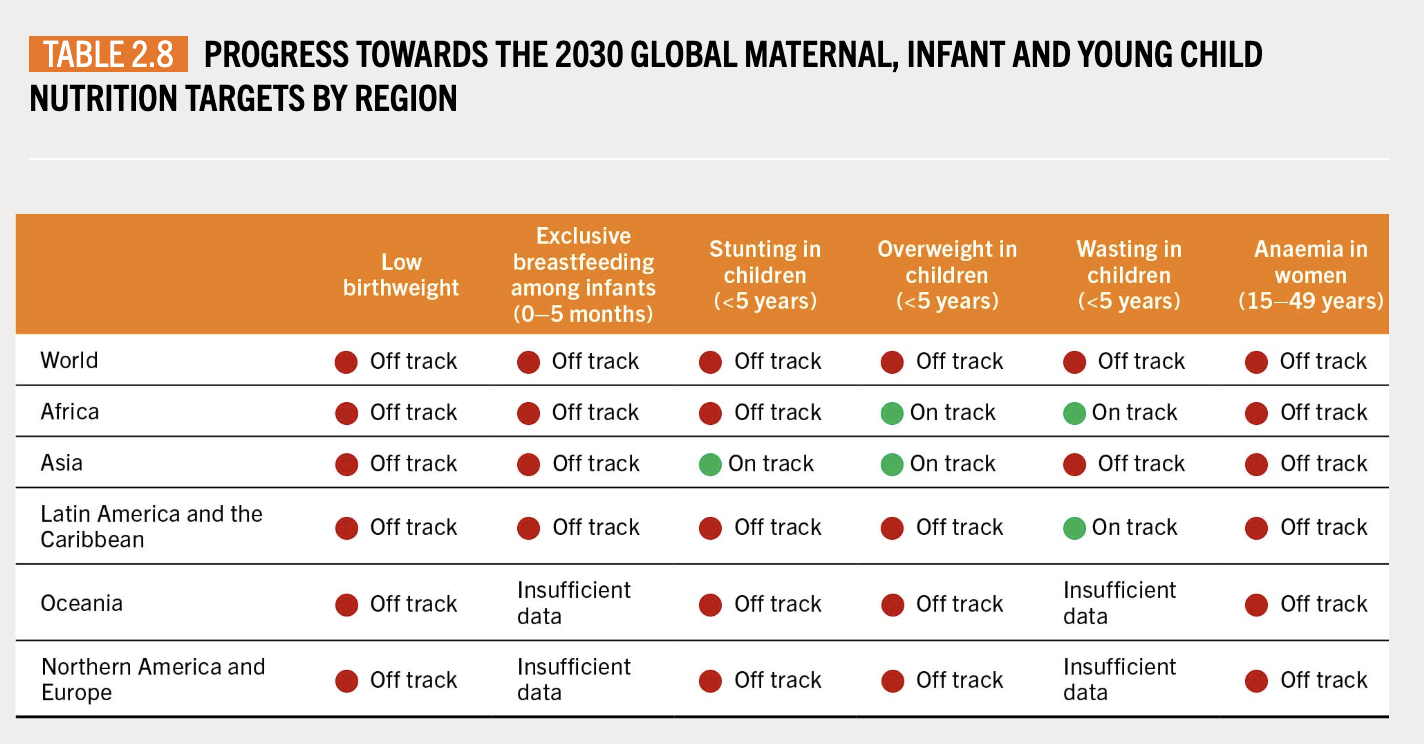
Analysis from SOFI 2026 report (FAO)
The stakes are rising. Conflict, climate change, inflation, tariffs, and geopolitical shocks all affect food prices and food access. When prices rise, households do not simply buy less food — they often buy less nutritious food. Diet diversity declines. Women and children are often hit first and hardest. In other words, shocks to food systems, and many other systems, are also shocks to nutrition. This is why nutrition cannot be treated as a sub-theme within broader debates on food, climate, or geopolitics. It sits at the intersection of all three.
The danger today is not that nutrition has disappeared from the agenda. It is that it is being folded into other priorities without enough explicit attention of its own. Food systems are important, but food systems do not automatically produce healthy diets. A system can be efficient, resilient, and climate-smart and still fail to improve nutrition. Unless nutrition is named, measured, financed, and held accountable, it can easily be assumed rather than delivered.
That is the lesson from nutrition’s history. The issue gains ground when it is attached to a larger political narrative — but it only stays visible when it remains a distinct objective. The 1000 days agenda worked because it was specific. SUN worked because it created a coalition and a sense of urgency. While SUN has brought countries together around nutrition, participation has not become universal and countries committing to SUN appears to have slowed. Nutrition-sensitive agriculture mattered because it tried to make nutrition everyone’s business. But each time the field broadened, the risk of dilution grew too.
Maybe we nutritionists aren’t needed anymore – undernutrition is slowly coming down, and now, GLP-1s are the “saviors” of the obesity pandemic…I think you all know I am being a bit sarcastic here, but truly, what is next? Will another report or a global meeting that focuses solely on nutrition help? Likely not. Even more so, is international development dead? I really hope not…but it ain’t lookin’ so good for 2030 if things stay as they are.
So, what comes next? Right now, with the current world order, I have no clue, my friends. Perhaps it is One Health. Perhaps it is climate-nutrition links. Perhaps it is a stronger focus on resilient diets, commercial determinants of health, or the health consequences of food environments. Maybe it’s everything, everywhere, all at once. Whatever the next frame is, it should not replace nutrition. It should protect it.
Because nutrition is not a luxury issue to be revisited when the world has time. It is foundational to human development, resilience, and equity. If the world is serious (which is questionable at the moment) about reducing poverty, improving health, strengthening food security, and building climate resilience, then nutrition must remain visible — not just as part of the conversation, but as a priority in its own right.
The next global agenda post 2030 should not have to rediscover nutrition all over again. It should learn how to keep it there.