Has Nutrition Been Lost in the Shift to Food Systems?

I was having a lovely catch-up with my good friend and colleague Stineke Oenema, the former Executive Secretary of UN Nutrition, and we were discussing the current “positioning” of nutrition. Nutrition has always been important. The problem is that it rarely stays at the center of global development attention for long.

For decades, the international agenda has moved in waves. In the mid-20th century, the priority was food security: preventing famine, increasing yields, and making sure countries had enough to eat. Later, nutrition emerged more explicitly as a development goal in its own right. The first 1,000 days framework helped focus attention on a critical period in child development. The Scaling Up Nutrition (SUN) Movement created a political platform (RIP David Nabarro). Nutrition-sensitive agriculture pushed the idea that farming should do more than produce calories — it should improve diets.

Now the dominant frame is food systems. That shift has brought real value. It has helped connect production, trade, diets, health, climate, and resilience. It has broadened the conversation in useful ways that take on the holistic nature of food as an interconnected system that should not be dealt with as isolated activities without consequences. But it also raises an uncomfortable question: when nutrition is absorbed into a bigger agenda, does it gain strength — or lose visibility?

That question matters because nutrition has never been a narrow technical issue. It is multi-causal and deeply political. It depends on food, yes, but also on health services, clean water, sanitation, education, income, social protection, and care. No single ministry or institution can fix it alone. That complexity makes nutrition harder to govern than many other development priorities. It is everyone’s concern, which too often means it becomes no one’s responsibility.

And yet the case for nutrition has never been stronger. Every country in the world faces some form of malnutrition. In some places the challenge is undernutrition and stunting. In others it is micronutrient deficiencies. Elsewhere it is overweight, obesity, and diet-related disease. Often, all of these coexist. Malnutrition is not just a problem of the past—it is a defining feature of the present.

It is not all terrible. In the just-released State of Food Insecurity Report, also known as “the SOFI,” produced annually by FAO et al, they show that global progress on reducing stunting, wasting, and overweight among children under five years of age is improving, but “marginally.” Yet, the data suggests that child stunting has declined substantially in Africa. The region is also on track to achieve the child overweight and wasting targets, with projections indicating that both targets will be surpassed by 2030. Asia is on track to meet the 2030 goal for stunting (which is a 40 percent reduction in the number of children under five years of age who are stunted). That is incredible!

However, not all is quiet on the western front either. Progress on reducing undernutrition is mixed when looking at regions, countries, and within pockets of countries, and meeting the 2030 targets shows there is still a lot of work to do (look at all that red in the SOFI graphic below). Some countries are really struggling. Anemia among women is getting much worse. We worked on a Lancet Hematology Commission this past year to draw more attention to anemia, which has devastating consequences for women. Obesity among adults continues to increase, but perhaps the GLP-1 drugs may halt some of this rise, eventually (that is, if they become widely available, cheap, and don’t cause known/unknown harms).
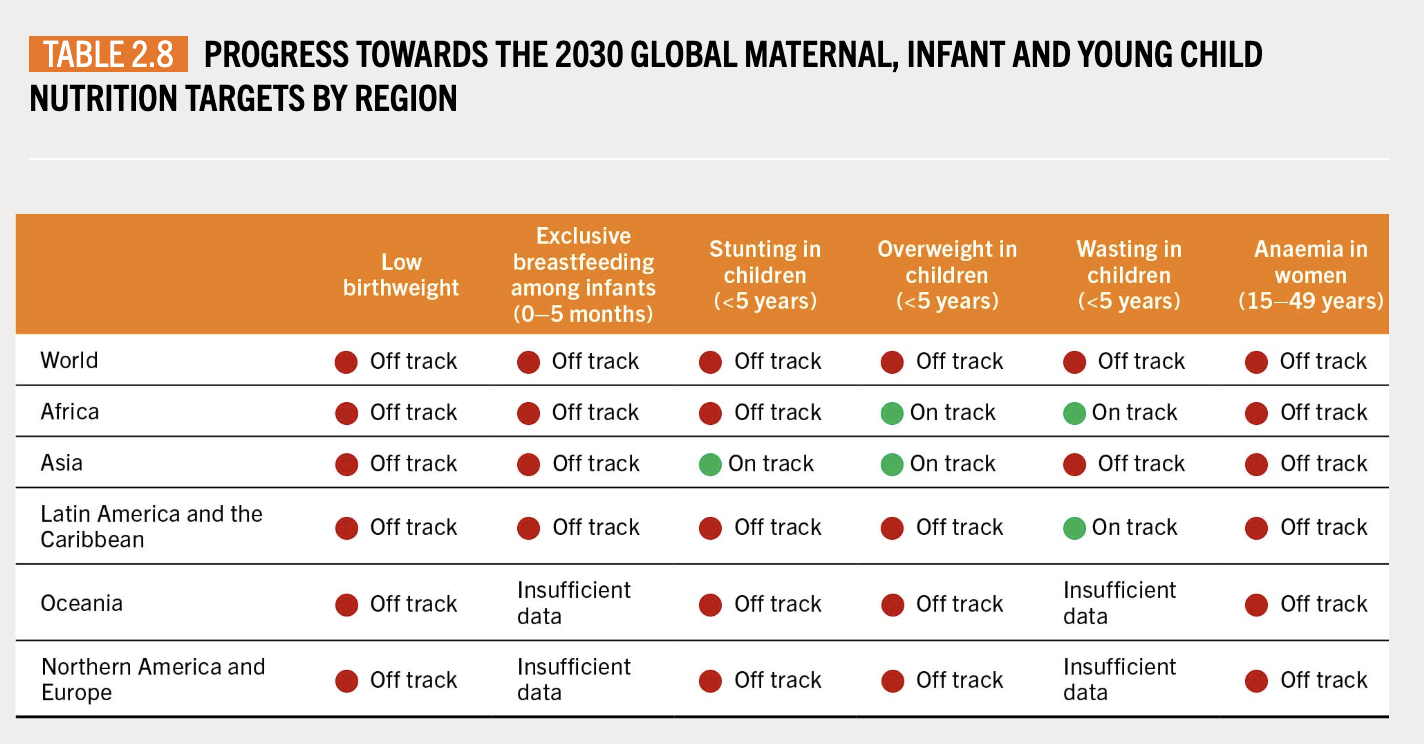
Analysis from SOFI 2026 report (FAO)

The stakes are rising. Conflict, climate change, inflation, tariffs, and geopolitical shocks all affect food prices and food access. When prices rise, households do not simply buy less food — they often buy less nutritious food. Diet diversity declines. Women and children are often hit first and hardest. In other words, shocks to food systems, and many other systems, are also shocks to nutrition. This is why nutrition cannot be treated as a sub-theme within broader debates on food, climate, or geopolitics. It sits at the intersection of all three.

The danger today is not that nutrition has disappeared from the agenda. It is that it is being folded into other priorities without enough explicit attention of its own. Food systems are important, but food systems do not automatically produce healthy diets. A system can be efficient, resilient, and climate-smart and still fail to improve nutrition. Unless nutrition is named, measured, financed, and held accountable, it can easily be assumed rather than delivered.

That is the lesson from nutrition’s history. The issue gains ground when it is attached to a larger political narrative — but it only stays visible when it remains a distinct objective. The 1000 days agenda worked because it was specific. SUN worked because it created a coalition and a sense of urgency. While SUN has brought countries together around nutrition, participation has not become universal and countries committing to SUN appears to have slowed. Nutrition-sensitive agriculture mattered because it tried to make nutrition everyone’s business. But each time the field broadened, the risk of dilution grew too.

Maybe we nutritionists aren’t needed anymore – undernutrition is slowly coming down, and now, GLP-1s are the “saviors” of the obesity pandemic…I think you all know I am being a bit sarcastic here, but truly, what is next? Will another report or a global meeting that focuses solely on nutrition help? Likely not. Even more so, is international development dead? I really hope not…but it ain’t lookin’ so good for 2030 if things stay as they are.

So, what comes next? Right now, with the current world order, I have no clue, my friends. Perhaps it is One Health. Perhaps it is climate-nutrition links. Perhaps it is a stronger focus on resilient diets, commercial determinants of health, or the health consequences of food environments. Maybe it’s everything, everywhere, all at once. Whatever the next frame is, it should not replace nutrition. It should protect it.

Because nutrition is not a luxury issue to be revisited when the world has time. It is foundational to human development, resilience, and equity. If the world is serious (which is questionable at the moment) about reducing poverty, improving health, strengthening food security, and building climate resilience, then nutrition must remain visible — not just as part of the conversation, but as a priority in its own right.

The next global agenda post 2030 should not have to rediscover nutrition all over again. It should learn how to keep it there. 

Food Bytes: September 2025 Edition

FOOD BYTES IS A (ALMOST) MONTHLY BLOG POST OF “NIBBLES” ON ALL THINGS CLIMATE, FOOD, NUTRITION SCIENCE, POLICY, AND CULTURE.

Food Bytes is back after taking August off (already practicing my ferragosta!). I think I say this every month, but it is hard to keep up with all the fantastic science and reports coming out. So let’s get to it.

The “Feeding Profit” report, published by UNICEF, argues that today’s food environments are systematically failing children by flooding markets and everyday spaces with cheap, ultra-processed foods that are aggressively marketed, thereby limiting access to nutritious choices. The data support this. Globally, 5% of children under the age of 5 and 20% of children and adolescents aged 5–19 live with overweight, and for the first time in 2025, obesity among 5–19-year-olds (9.4%) has overtaken underweight (9.2%). In many low- and middle-income countries, the prevalence of overweight individuals has more than doubled since 2000, and these countries now account for 81% of the global overweight burden (compared to 66% in 2000). The report finds that children’s diets are increasingly dominated by ultra-processed foods and sugary drinks, displacing more nutritious options, such as fruits, vegetables, whole grains, pulses, and animal-source foods (see the figure on the right). It highlights that for infants and children aged 6–23 months, only a minority meet minimum acceptable diet standards — e.g., globally, ~61% meet the minimum meal frequency standard, but only ~32% achieve the minimum dietary diversity (i.e., ≥ 5 food groups). It emphasizes that food environments—encompassing pricing, availability, marketing, and convenience—strongly shape diet quality, and that poor diets are not merely individual choices but are structurally driven by unhealthy food systems that food and beverage companies often interfere with and manipulate. Finally, it advocates for reforms such as reallocating agricultural and trade subsidies toward nutritious foods, regulating marketing and labeling, and enhancing social protection to make healthy diets more accessible and affordable.

Speaking of unhealthy foods, the Nature article, “Are ultra-processed foods really so unhealthy? What the science says,” scrutinizes whether the broadly used category of ultra-processed foods is scientifically justified, arguing that the classification may be overly heterogeneous to guide nutrition policy. While numerous observational studies link the consumption of ultra-processed foods to obesity, metabolic disease, and mortality, critics counter that many of these associations stem from confounding factors (e.g., overall diet quality, energy intake) rather than the definition of ultra-processed foods itself. The piece calls for improved definitions, mechanistic studies, and nuance in policy action, suggesting that a one-size-fits-all ban or tax on these foods may misfire without a clearer scientific basis. I think many working in this space disagree….

The study “Benchmarking progress in non-communicable diseases analyzes changes in cause-specific mortality across 185 countries from 2010 to 2019, utilizing age-specific death rates and life-table methods to estimate the probability of dying from non-communicable diseases before the age of 80. During that period, non-communicable disease mortality declined in 82% of countries for females and 79% for males; however, the pace of decline slowed compared to 2001–2010, and in a minority of countries, the probability increased. Circulatory diseases contributed most to mortality reductions, while neuropsychiatric disorders, pancreatic and liver cancers, and diabetes offset gains in many settings.

Moving on to the area of sustainable diets, an interesting report , Meat vs EAT, was released last week, revealing a coordinated online backlash against the EAT Lancet Commission report. The backlash was driven by a network of 100 mis-influencers responsible for nearly 50% of posts and over 90% of engagement during the initial backlash. ​ Key hashtags, such as #Yes2Meat, reached 26 million people, surpassing the 25 million reached by pro-EAT-Lancet posts, with critical messages being shared six times more frequently than supportive ones (see Figure to the left). ​ Industry ties were evident, while mis-influencers monetized their advocacy through books, subscriptions, and events. None of this is shocking. With the second Commission report coming out this week, and the current global political turmoil, it will be interesting to see how they address the Commission's findings and its scientists. Their playbook? Attack the scientists, not the science. Boooo!

Let’s stay on this broad topic. A new study highlights the significant health impacts of anthropogenic climate change, including deaths, illnesses, and disabilities, with a focus on heat-related mortality, extreme weather events, and diseases like malaria and dengue. While most research has concentrated on high-income countries and temperature-related risks, recent studies have expanded to include air pollution, child health, and displacement, revealing substantial economic losses valued in billions annually. ​ The authors emphasize the need for more geographically diverse and equitable research, particularly in the global south, to better understand and address the health consequences of climate change.

Speaking of climate change, this study uses US household food purchase data (2004–2019) linked with meteorological records to quantify the effect of temperature on added sugar consumption. Results show that intake rises sharply between 12 °C and 30 °C (~0.7 g °C⁻¹), driven primarily by sugar-sweetened beverages and frozen desserts, with disproportionately larger effects among lower-income and less-educated groups. Projections under a 5 °C warming scenario suggest average daily added sugar intake will rise by ~3 g per person by 2095, exacerbating nutrition-related health risks and inequalities. Interesting study? Yes, we need to understand how climate extreme events impact dietary quality and nutrition outcomes. But are the findings significant? Probably not…3 grams of sugar ain’t much…

And to pivot a bit, the Lancet published "Getting back on track to meet global anaemia reduction targets: a Lancet Haematology Commission." The Commission assesses why the world is far off track to meet global anaemia reduction targets and provides a roadmap to get efforts back on course. As it stands, anaemia affects nearly 2 billion people worldwide, and most countries are far off track to meet reduction targets. Five takeaways:

  1. Anaemia has multiple drivers, from poverty, food insecurity, and poor WASH to infections, chronic diseases, and inherited blood disorders. Recognising this complexity is key to designing context-specific solutions.

  2. Reliable surveillance is patchy. Nearly half of the countries lack recent national anaemia data for women or children, and almost none collect comprehensive cause-specific information. Better integrated data platforms are urgently needed.

  3. Iron deficiency remains the leading cause, but infections, inflammation, micronutrient deficiencies, blood loss, and environmental stressors (like air pollution and climate change) all play major roles. Interventions must address this whole spectrum.

  4. Reducing anaemia requires strong governance across health, nutrition, and social sectors. Equity and human rights should be central, ensuring programmes reach the most vulnerable while being tailored to local contexts.

  5. The current WHO target of a 50% reduction by 2030 is unattainable with existing tools. A new evidence-based framework suggests a more realistic 12–22% global reduction, with country-specific goals that balance ambition and feasibility.

A companion article, “Anaemia in a time of climate crisis” published by your Food Archiver surveys how climate change — through effects like extreme heat, altered rainfall, and reduced agricultural yields — threatens to exacerbate global anaemia. It argues that vulnerable populations (especially women and children) in already high-burden settings will face worsening micronutrient deficits unless interventions integrate climate resilience into nutrition and health systems.

Gotta love Molly, oh how I miss the 80s!

A few interesting media pieces for your reading pleasure:

  • Sushi has become the grab-and-go, convenient food. Interesting how something raw has become so mainstream. (love the shoutout to Molly Ringwald in Breakfast Club)

  • An article on the beauty and craft of pizza.

  • I recently traveled to Mexico City and had a hard time finding good Mexican food. Why? Damn gringos are all moving there demanding, you guessed it, sushi and pizza.

  • Fantastic piece by Illana Schwartz, a Columbia University climate student, on the climate vulnerability of NY’s food supply, particularly the Hunts Point Cooperative Market, the point of distribution for 35 percent of the meat that enters the five boroughs. That’s more than 1 billion pounds of meat annually.

  • A Guardian article on why meat’s contribution to climate is often ignored by the media.

  • Breaking the trend of consolidation, Kraft Heinz, the makers of Kraft Mac and Cheese, Lunchables, and, you guessed it, Heinz ketchup, is breaking up:

  • Last, an important article on what happens to children when they become increasingly acutely malnourished. Recall that FEWS Net and others have declared that many parts of Gaza are now experiencing famine. Incredibly tragic.

And some final random thoughts. The great Italian actress Claudia Cardinale passed away this week. We were inspired to watch her in Werner Herzog’s Fitzcarraldo. Such an insane movie. Even better is to watch the making of it in the documentary, “Burden of Dreams.” Herzog is at his finest when he discusses nature and the jungle…His words resonate on the fragility of our world and humans in it.