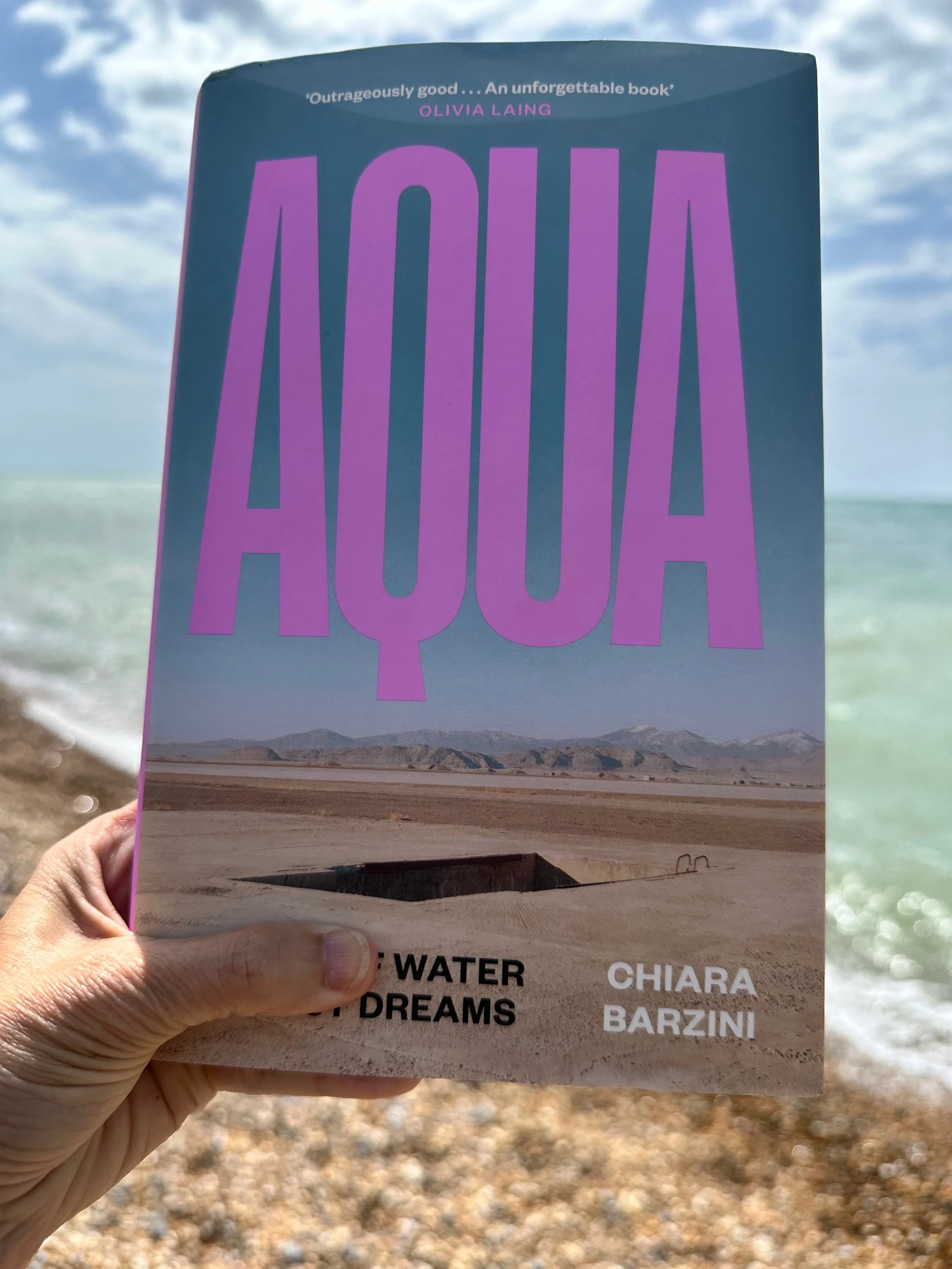
I read Chiara Barzini's Aqua with great intrigue, having the pleasure of knowing the author. This familiarity added an extra layer of warmth to an already captivating narrative, in which Barzini famously lets fate set her course on a winding road trip with two of her best pals, exploring the historic (and somewhat insane) Mulholland Aqueduct project to bring water from the mountains 233 miles away to Los Angeles.
The book also intrigued me because water and food insecurity are inseparable. When access, availability, and basic rights to these resources are challenged, they don't just spark wars—they become weapons.
This sense of fragile, manufactured illusion becomes even more striking when you look at the fundamental absurdity of California’s water crisis. Aqua uncovers an inescapable truth: a massive, sprawling civilization was erected in a region that has always been fundamentally water-deprived, operating on the hubristic assumption that nature could be humanely engineered to solve the deprivation, a la John McPhee’s The Control of Nature.
Today, a toxic cocktail of long-term systemic mismanagement and climate change has pushed the city — and, moreover, the state — to its breaking point, painfully echoing the "Limits to Growth" theory—the reality that infinite consumption cannot sustain itself on a finite planet. Watching a metropolis like Los Angeles constantly lurching from one catastrophic drought (or wildfire or atmospheric river phenomena), along with various infrastructure failures, makes it feel less like a series of modern emergencies and more like an inevitable destiny. It is a stark reminder that when you build an “empire” on a landscape which is inherently a semi-arid, Mediterranean ecosystem, the crisis isn't an accident; it's inevitable.
Her voice shines through in several standout ways. She highlights the vibrant, nostalgic energy of 1960s and 70s hippie-cult California through a personal lens—not just as an observer, but as someone whose own identity is deeply entangled with its myths, its magic, and its modern fractures. This history is established by her injection of intimate personal anecdotes, seamlessly weaving her roles as a mom, a daughter, a friend, a wife, and a writer into the larger geographical crisis. You can see how much the beloved Joan Didion influenced her writing and psyche. There are so many great bits about the culture of Los Angeles - from the movie Chinatown, Father Yod of the Source, to the Manson murders.
As one reads Aqua, her yearning for a Los Angeles that no longer exists, much like its water security, “drips” from the pages. In the book, it seems she is beginning to reckon with that loss. I wrote about yesteryear California back in 2024, when we spent part of the summer in Los Angeles (and so did my partner in his blog). As I wrote: “We always thought we might return to live on the West Coast, but our vision of what we think California should be is over, finished. It went in another, less interesting and unauthentic direction long ago.” It is hard to admit when your home is no longer your home, and Barzini, in her journey to trace the aqueduct that quenched LA, seems to be realizing that through various moments she witnesses and personally experiences. Barzini admits to being wooed by Hollywood, the fame, the dazzling and glossy illusion of the American Dream. In A Field Guide to Getting Lost, Rebecca Solnit captures this ethos, describing a "glittering, amnesiac Los Angeles"—a city devoid of communal memory that eagerly incinerates its own history for the sake of perpetual reinvention. Reading Barzini, one feels a distinct melancholy as she comes to terms with the fact that those pipe dreams will never be realized.
For example, what genuinely broke my heart was her side story regarding the screenplay adaptation of her previous novel, Things That Happened Before the Earthquake. Watching her recount her agonizing experience with the Hollywood movie machine—which ultimately culminated in a crushing rejection from a famous director—was nothing short of visceral. She lays bare the fickle, cold-hearted nature of an industry that treats artists as largely disposable, and while the outcome itself wasn't terribly surprising given how Hollywood operates, it was brutal to read someone navigate that system (and one she is already connected with). Yet, it serves as a powerful thematic anchor for Aqua, mirroring the broader reality of California itself: a place built entirely on beautiful, mirage-like illusions that so often leave people “parched.”
However, looking at the book objectively as a non-fiction reader and a scientist, I found a couple of areas where I craved a bit more depth. When diving into complex regional water security and access issues, I generally prefer a heavier reliance on hard facts and thorough citations (and maybe more interviews with experts), whereas Aqua leans much more toward an impressionistic, narrative style, leaving some data points feeling a bit sparse or even anecdotal.
Given that Barzini considers Rome and Los Angeles her two homes, the narrative misses a powerful opportunity to undertake a deeper, more rigorous comparative lens—one that fully unearths how water scarcity and failed dreams uniquely intersect across these two landscapes. Exploring how both of these grand worlds grapple with their own structural and cultural droughts could have elevated the book's narration to even greater heights.