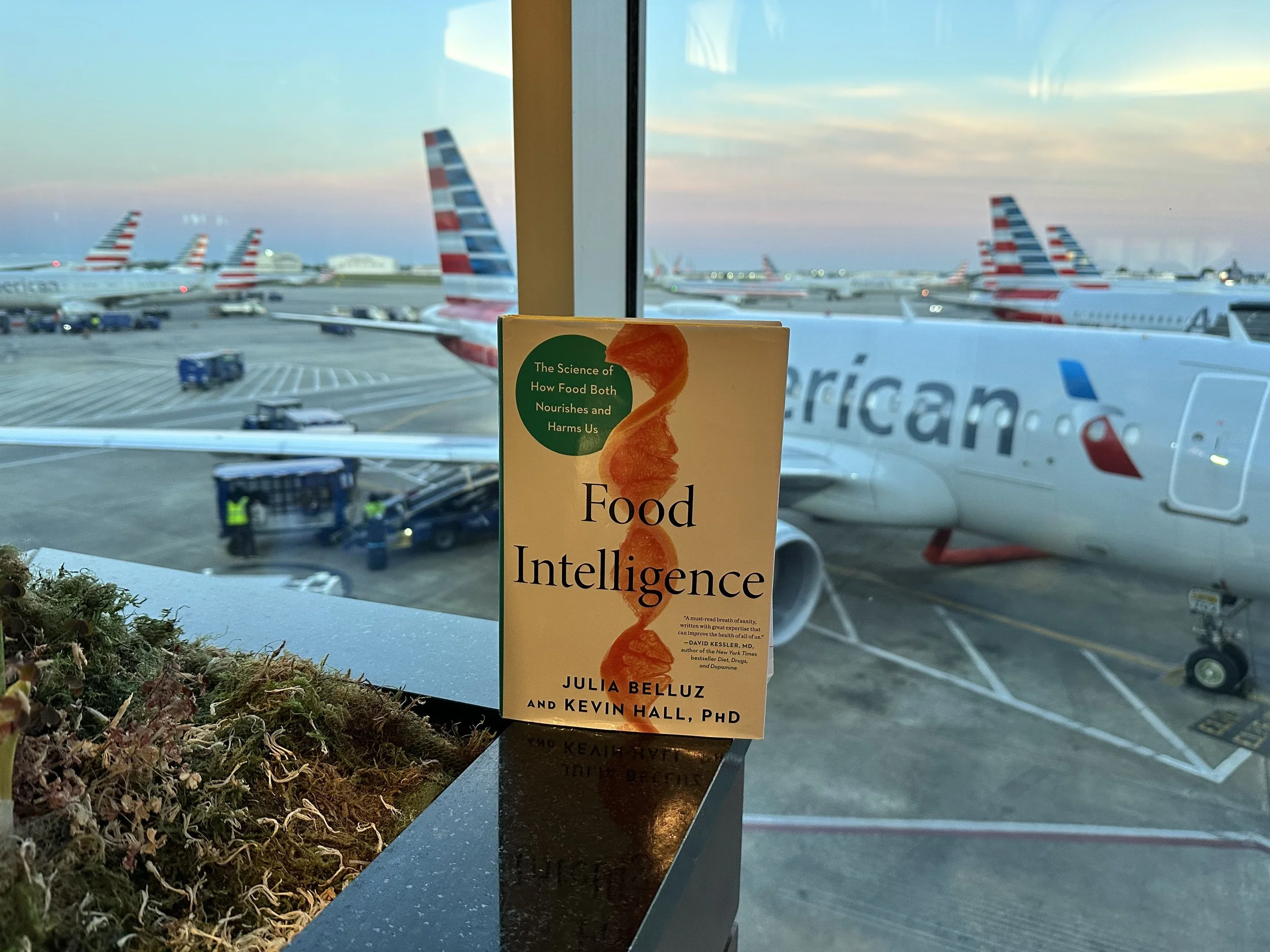
Book Review: Food Intelligence

While traveling to North Carolina and away from the daily grind of work, I was finally able to read a book—a miracle in itself! I chose Food Intelligence, co-authored by Kevin Hall and Julia Belluz. The fact that the book is written equally by both takes a bit of getting used to, especially since they use the third person when referring to themselves. I am not sure it totally works, but I am also not sure how else one would co-author such a book.

The book is incredibly informative, particularly regarding Dr. Kevin Hall’s research. Hall is a biophysicist and was a senior investigator at the NIH until 2025. He is renowned for his highly rigorous "metabolic ward" studies, which often house participants in clinical settings where every calorie, movement, and biological secretion is precisely measured.

Kevin spent years at the NIH conducting clinical trials to study metabolism, weight loss, and the impact of specific foods (particularly ultra-processed foods) on body weight. In one of his most famous studies, he found that when people ate ultra-processed foods, they spontaneously consumed about 500 extra calories per day and gained weight. Conversely, when on an unprocessed diet, they lost weight. He argues that the energy density and hyper-palatability of these foods—driven by the processing itself—trigger weight gain, rather than just "too many carbs" or "too many fats."

In fact, he has conducted trials comparing low-carb and low-fat diets, finding that a low-fat diet actually resulted in slightly more body fat loss than an equal-calorie ketogenic diet. In essence, "a calorie is a calorie" is a fairly accurate rule. However, he notes that the old "3,500-calorie deficit equals one pound of weight loss" rule is not linear. He also studied contestants from The Biggest Loser and showed that, even years after the show, their metabolisms had slowed significantly more than expected for their new body size. This "metabolic adaptation" (or "starvation response") persisted even when they regained the weight.

His departure from the NIH (which clearly happened after the book was published) was highly publicized and controversial, as he cited a breakdown in scientific integrity and political interference as his primary reasons for leaving. It sounded like he was in the middle of several trials at the time, which is a real shame for the field.

While the book is an excellent primer on metabolism, I wish it had tackled GLP-1 drugs head-on. These medications are the "missing link" for much of Hall’s research. By mimicking natural hormones, drugs like Ozempic and Mounjaro do three things:

  • Mute "Food Noise": They signal the hypothalamus to dampen the brain's reward centers.

  • Slow Digestion: They delay gastric emptying, so you feel full longer.

  • Stabilize Blood Sugar: They manage insulin and glucagon to prevent the spikes that drive hunger.

This leads to a natural calorie deficit and—most importantly—a shift away from the ultra-processed foods Hall spent his career studying.

The authors lean heavily into the "toxic food environment" theory—the idea that our system, not our willpower, is the problem. I agree 100%. But it leaves me wondering: if we "solve" the hunger signal with a pill, will we still have the political will to fix the food system? Or will fixing the environment become a non-issue once the price of these drugs drops? We are in the middle of a massive "live experiment."

In the final chapters, they pivot to the wider food system. I was interested to see how a biophysicist and a journalist would frame the food system’s contribution to nutrition and metabolism. While they got the big picture right, the analysis felt a bit shallow. It didn't feel like it added much to the book's core value, and they seemed to throw softballs at potential solutions to the issues Kevin witnessed and analyzed during his trials.

Overall, Food Intelligence is a truly interesting read about the state of weight-loss research.

What We Lost in 90 Days

We keep hearing words like “chaotic,” “unprecedented,” and “unconstitutional.” All accurate. Many of us anticipated that the new U.S. administration would threaten liberties, freedoms, and equity—but few could have predicted just how rapidly and recklessly core institutions would be dismantled.

In less than 90 days, we witnessed the gutting of the scientific enterprise and the destabilization of knowledge-based institutions—universities, NIH, NASA, NOAA—and the agencies responsible for delivering lifesaving food and medicine globally. The scale and speed of this erosion is staggering.

It is cruel. It is shortsighted. And it is a profound national failure. Without science, data, and evidence, we become untethered—adrift in a sea of absurdity.

Amid this darkness, I’ve found some glimmers of hope in the powerful journalism and commentary calling out this injustice. Below, I’ve highlighted a few pieces worth your time. I urge you to read them.

In the American Journal of Clinical Nutrition, Lindsey Locks and colleagues describe the abrupt withdrawal of the U.S. from the World Health Organization and the dismantling of USAID as colossal, unforced policy failures with immediate humanitarian consequences. These decisions not only threaten the world’s poorest populations but also undermine global health, nutrition science, and the United States' diplomatic standing. The fallout spans four critical domains:

  1. Lives Lost: Humanitarian, health, and nutrition programs are being disrupted, with fatal consequences.

  2. Livelihoods Destroyed: Both in the U.S. and globally, aid-related jobs and economies are collapsing.

  3. Expertise and Infrastructure Undone: Vital institutions, data systems, and research efforts tackling food insecurity and malnutrition are being eroded.

  4. Global Presence Withdrawn: U.S. programs promoting health, education, peace, and solidarity in hundreds of countries are vanishing—leaving a dangerous diplomatic and humanitarian void.

Osendarp et al 2025 Nature

Osendarp and colleagues expand on this in Nature, warning that the dismantling of USAID and announced cuts by other major donors over the next 3–5 years risk reversing decades of progress in malnutrition reduction. The numbers are devastating: a $290 million cut to programs for severe acute malnutrition would mean 2.3 million children lose access to treatment—resulting in an estimated 369,000 preventable child deaths annually.

The domestic scientific community is also suffering. In Science, John Travis reports on the unclear but growing toll among U.S. scientists. A leaked NIH memo revealed that the Department of Health and Human Services—which houses the NIH, CDC, and FDA—had planned to cut approximately 5,200 employees, though some were spared at the last minute.

In a sobering Science editorial titled “The New Reality for American Academia,” H. Holden Thorp urges U.S. universities to reckon with public trust and relevance. It's a worthy call, but difficult to embrace calmly when core institutions are crumbling. I was one of the 1,900 members of the National Academy of Sciences who signed a letter arguing:

“We hold diverse political beliefs, but we are united as researchers in wanting to protect independent scientific inquiry. We are sending this SOS to sound a clear warning: the nation’s scientific enterprise is being decimated.”

In it, we are concerned (this article about who we are) with the blows to funding, collaboration, and building a pipeline. Many of us trained here in the U.S in some of the great research institutions are prepared to jump ship. A recent Nature poll found that 75% of 1,600 scientists surveyed would consider leaving the U.S. for jobs abroad.

In The New England Journal of Medicine, Chris Duggan and Zulfi Bhutta write under the pointed title: “‘Putting America First’—Undermining Health for Populations at Home and Abroad.” They offer a call to action for scientists:

  1. Acknowledge the limitations of U.S. foreign assistance programs.

  2. Advocate for continued U.S. engagement with global institutions like WHO.

  3. Recognize how attacks on global health research mirror broader assaults on higher education and science.

Finally, Jocalyn Clark, international editor at The BMJ, turns our attention to equity in her powerful essay “The War on Equality.” She writes:

“Equality feels like oppression to those accustomed to privilege, the adage goes. To certain petty political leaders and their supporters, it must. There is no other explanation for the current erasure of support for diversity and inclusion efforts... None apply in the authoritarian playbook. The present war on equality demands action from us all.”

This all deeply saddens me. It’s hard to fathom—let alone fully absorb—the scale of what has been lost, all in just a matter of months. The enormity of rebuilding, in whatever new forms may emerge, is likely to take decades—if it happens at all. What could be lost forever is the extraordinary scientific legacy: the knowledge, the networks, the momentum, and the spaces that once nurtured curiosity, collaboration, and discovery. We can’t keep our heads down, hoping for a miracle. We have to stand up and fight for what truly matters. For me, science is one of those things—worth defending, worth rebuilding, worth mourning.