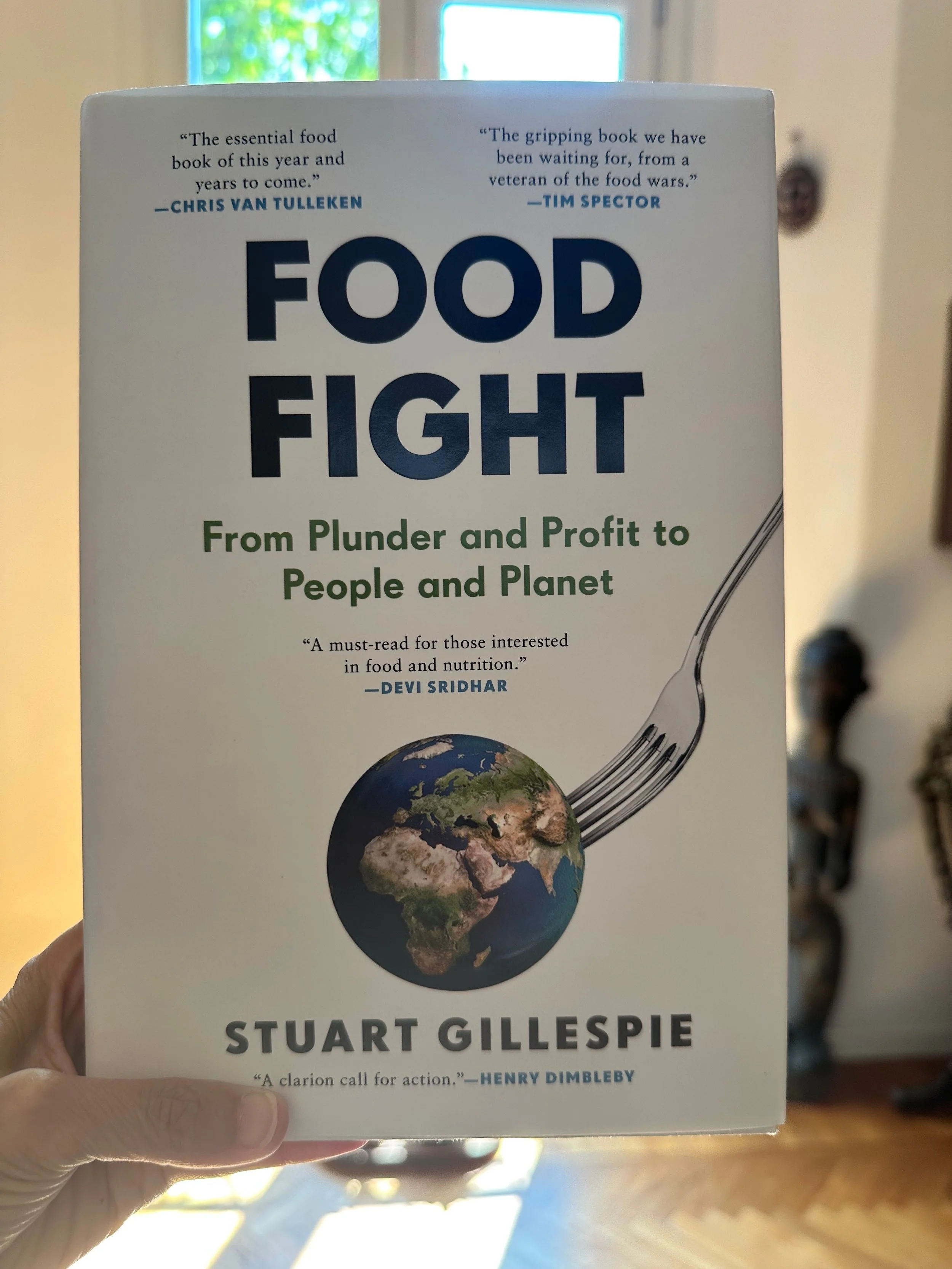
I recently finished Stuart Gillespie's Food Fight: From Plunder and Profit to People and Planet, and as someone who has spent decades in the nutrition and food systems space, I found myself nodding along, occasionally surprised, and ultimately grateful that someone with Stuart's credentials is asking and answering these questions.
What makes this book interesting is watching Stuart's own intellectual journey unfold on the page. His career, spent largely in the trenches of undernutrition work, both in the field and through institutions like UNICEF and IFPRI, gives him a particular authority when he pivots to discussing overweight, obesity, and the rise of ultra-processed foods. This isn't someone parachuting into the obesity conversation from the outside; it's someone who has spent a career watching malnutrition in all its forms and is now grappling with how the food system itself needs to be understood as the common thread.
That depth of experience shows throughout the book. He's clearly been in the room for many pivotal nutrition moments over the years, and while his focus has historically leaned toward undernutrition, that lived history gives the book real weight. He is a very eloquent, clear writer, and the book has bits and bobs of Stuart’s dry sense of humor throughout.
What comes through most clearly, and what I most appreciated, is Stuart's genuine passion for confronting the power imbalances between the food and beverage industry and public health nutrition. This isn't academic handwringing. The book reads as someone who has watched these dynamics play out over a long career and has had enough.
What Stuart does particularly well is quantify just how lopsided this fight really is. It's one thing to intuitively know that food and beverage corporations have little genuine interest in public health outcomes, but it's another to see it laid out in hard numbers. He walks through the sheer scale of these companies: their revenues dwarf the GDPs of many nations, their marketing budgets make public health campaigns look like rounding errors, and their armies of lobbyists shape policy in capitals around the world. These aren't abstract power imbalances; they're structural, measurable, and deeply entrenched. Stuart backs this up with concrete examples such as regulatory capture, self-regulation failures, and the revolving door between industry and the very bodies meant to hold them accountable (wow, about the UN food systems summit!). What I appreciated is that he doesn't just leave us despairing at the size of this monolith. He offers genuine pathways forward: strengthening regulatory frameworks with teeth, building coalitions that can match industry's resources with collective voice, learning from tobacco control's slow but eventual wins, and reclaiming the evidence base from industry-funded research. It's a sobering picture, but not a hopeless one.
Here's what I enjoyed most: the deep-dive histories. I already knew the broad strokes of stories like Nestle's breastmilk substitute code violations or the Triple-A approach in Inringa, Tanzania. These aren't new stories to those of us in the field. But Stuart's research brings them to life in a way that made me appreciate them anew. It's a reminder that even familiar stories benefit from careful, thorough retelling by someone willing to do the archival work.
I was surprised, though, that the EAT-Lancet Commission didn't make an appearance. Whatever its caveats and flaws, EAT-Lancet was an important moment—not just for setting science-aligned goals, but as a case study in how industry (in this case the livestock industry) mobilizes against scientists whose findings threaten their business models. It would have fit naturally into Stuart's broader argument about power and pushback, and its absence felt like a missed opportunity. Building on that, it would have been great to get more of Stuart’s take on the “planet” side of food systems, as it is not feasible to discuss how food systems need to be healthier without considering their sustainability.
Stuart offers plenty of concrete examples for action, and I agree completely with his central claim: the nutrition community still hasn't fully grasped what "transformation" actually means or requires. But here's where I'll push back a little, drawing on my own scars from the field. Nutritionists have done a lot of navel-gazing. I spent years doing food systems work and got very little recognition or interest in the topic from the mainstream nutrition community. It was often treated as tangential, or not hard-hitting enough. And now, seemingly overnight, food systems transformation is everyone's priority.
I don't say this with bitterness, nor am I saying that Stuart was in that camp. I say this more with relief. I'm genuinely glad people like Stuart, with his credibility and reach, are now bringing food systems thinking into the nutrition mainstream. It's validating, even if it's taken a while to get here. Better late than never.
Food Fight is a worthwhile read for anyone in the field, whether you're new to these debates or, like me, have been in them long enough to remember when "food systems" wasn't yet a phrase nutritionists used.