Floods, droughts, earthquakes, pandemics and economic crises seem to hit our food systems more often every year. It is easy to assume that the countries facing the worst disasters are the ones where hunger rises the most. In a new paper in PNAS, we put that assumption to the test. Using data from the Food Systems Countdown Initiative, we tracked how disaster shocks and undernourishment correlated in more than 100 countries between 2011 and 2019. We also examined factors that might help a country absorb a blow, such as how well its government works, how diverse its food sources are, how wealthy it is, and how strong its community ties are.
The first surprise was that bigger shocks did not reliably lead to more hunger. When we plotted shock severity against changes in undernourishment, we found essentially no relationship. A group of countries in South and Southeast Asia stands out. India, the Philippines, Vietnam, Thailand, Nepal, and Japan all faced above-average disasters, from monsoons and typhoons to earthquakes, and yet hunger kept falling. Meanwhile, some countries that faced relatively mild shocks still saw hunger go up. In other words, a disaster is not destiny. What matters is whether a food system can bend without breaking, which is what we mean by resilience.
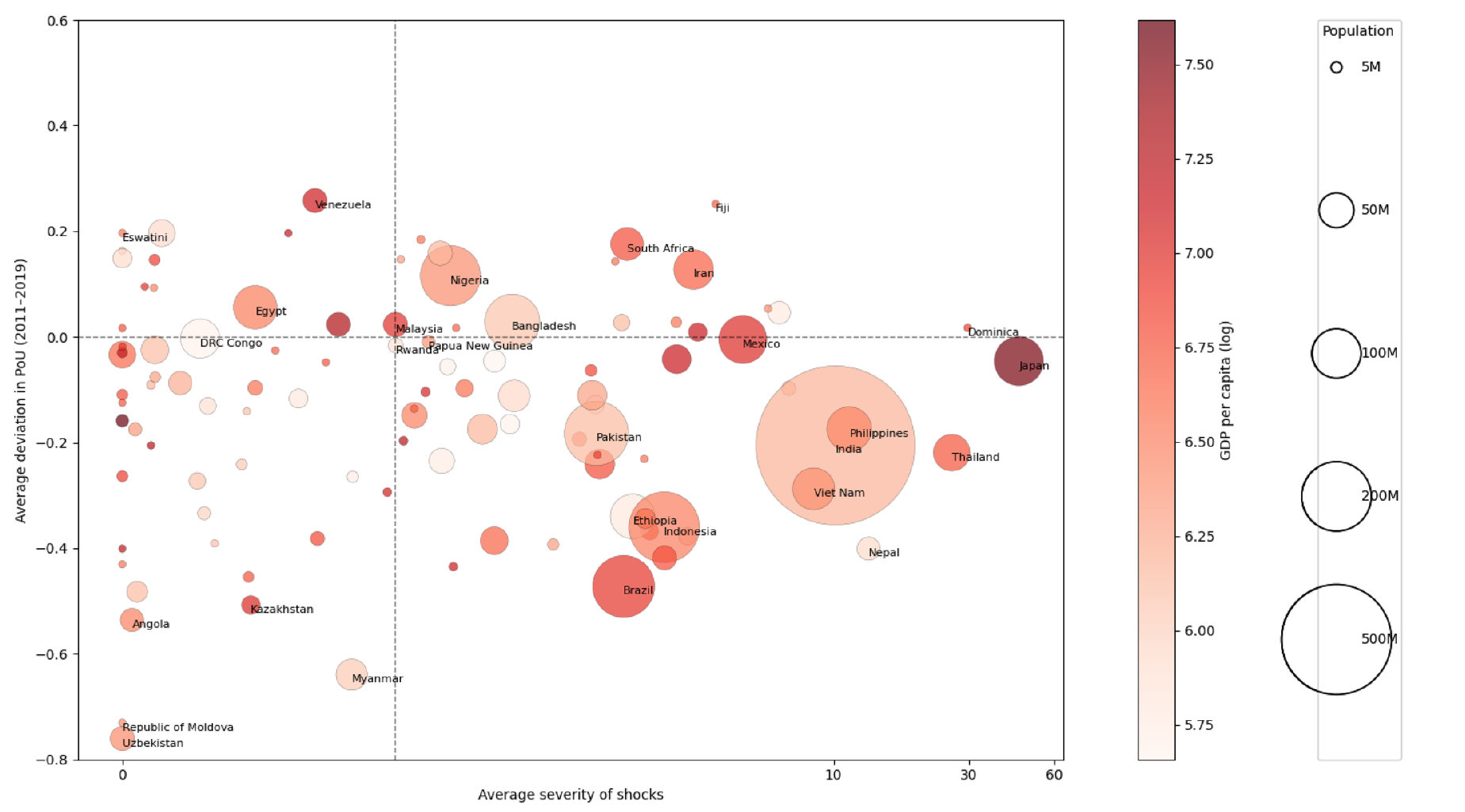
Each bubble is a country. Countries further right faced bigger disasters, and countries lower down saw hunger fall between 2011 and 2019. Bubble size shows population and darker colors mean higher income. Source Béné et al. (2026), PNAS, licensed under CC BY-NC-ND 4.0.
So what helps? Within a country, hunger was less likely to spike when governments became more effective, the economy grew, and the food supply drew on a wider mix of sources so losing one did not mean losing everything. When comparing countries, places with stronger social capital (the trust and networks that let people lean on each other) had steadier food security, while places with volatile food prices had bumpier rides. Interestingly, how much a country relied on imported cereals made no clear difference. The takeaway is hopeful. Resilience can be built, and investing in good governance, diverse food supplies, and strong communities can help break the link between a disaster and an empty plate.