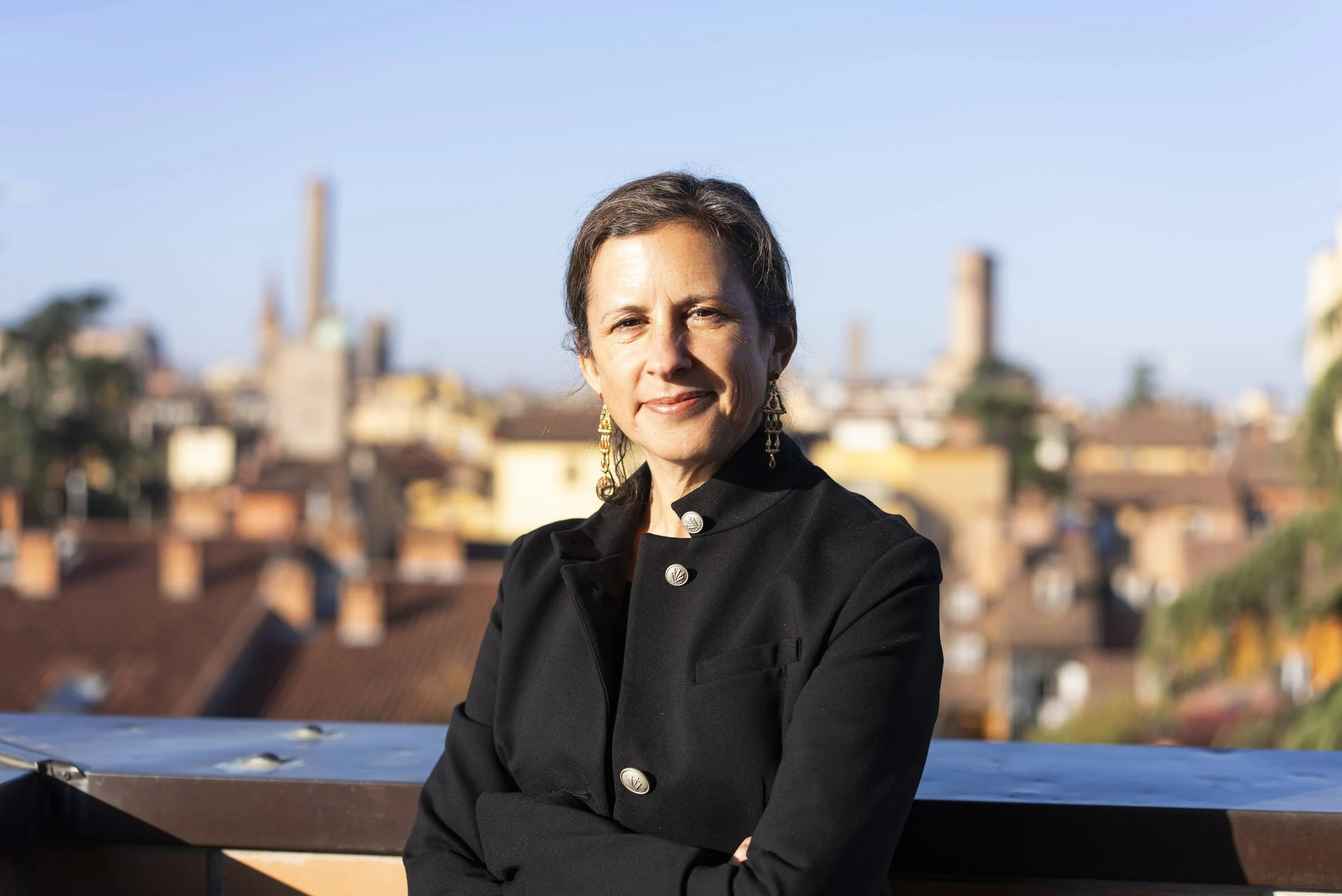
Jessica Fanzo, Ph.D., is the James Anderson Professor of Food Policy and Climate at Johns Hopkins University’s School of Advanced International Studies (SAIS) Europe in Bologna, Italy. Her transdisciplinary research discerns and analyzes the connections between climate change and food systems in nutrition- and climate-vulnerable communities living in resource-constrained settings, with a goal of identifying and exploring opportunities within food systems to enhance diet, nutrition, and environmental outcomes.
Before joining Johns Hopkins, Jess served as a Professor of Climate and Food and the Director of the Food for Humanity Initiative at Columbia University’s Climate School. Prior to that tenure, Jess was the Bloomberg Distinguished Professor of Global Food Policy and Ethics at Johns Hopkins University. She held appointments at SAIS, the Berman Institute of Bioethics, and the Bloomberg School of Public Health. She was the Director of Hopkins’ Global Food Policy and Ethics Program and the Director of Food & Nutrition Security at Hopkins’ Alliance for a Healthier World. From 2021 to 2022, Jess was the Vice Dean of Faculty Affairs at SAIS. She has also held positions at the Earth Institute, the Food and Agriculture Organization of the United Nations, the UN World Food Programme, Bioversity International, the Millennium Development Goal Centre at the World Agroforestry Center in Kenya, and the Doris Duke Charitable Foundation.
She leads the development of the Food Systems Dashboard and the Food Systems Countdown to 2030 Initiative in collaboration with GAIN. She currently serves in advisory roles for the AgMIP Steering Council and the Scaling Up Nutrition Movement Executive Committee, among others. She also serves on the boards of the International Livestock Research Institute and the Alliance of Bioversity and CIAT.
From 2017 into 2026, she has served on various collective endeavors, including the BIFAD Subcommittee on Systemic Solutions for Climate Change Adaptation and Mitigation in Food Systems for USAID, the High-Level Expert Group for the European Commission’s International Platform for Food Systems Science, Food Systems Economic Commission, the Cornell Atkinson Center’s Socio-Technical Innovation Bundles for Agri-Food Systems Transformation report, the Global Panel of Agriculture and Food Systems for Nutrition Foresight 2.0 report, and both the first and now second EAT-Lancet Commissions. She was also the Co-Chair of the Global Nutrition Report and Team Leader for the UN High-Level Panel of Experts on Food Systems and Nutrition, and served on the CGIAR’s Integrated Partnership Board.
Jess has been an advisor for various organizations and governments, including the Global Alliance for Improved Nutrition, the International Food Policy Research Institute, PATH, the Scaling Up Nutrition movement, the UN Standing Committee on Nutrition, USAID, the World Bank, and the World Health Organization. She was the Editor-in-Chief of the Global Food Security Journal from 2018 to 2022 and an Associate Editor of the American Journal of Clinical Nutrition from 2019 to 2022.
Jess has authored over 200 peer-reviewed scientific articles, 6 edited books, over 30 book chapters, and over 50 reports, manuals, and guidelines. In 2021, she published her first book, Can Fixing Dinner Fix the Planet? with Johns Hopkins University Press and co-wrote Global Food Systems, Diets, and Nutrition: Linking Science, Economics, and Policy, published by Palgrave Macmillan. To see her full list of publications, please explore here.
She was the first laureate of the Carasso Foundation’s Sustainable Diets Prize in 2012 for her research on sustainable food and diets for long-term human health. She was also elected to the National Academy of Sciences in 2024. She has a Ph.D. in Nutrition from the University of Arizona and completed a Stephen I. Morse postdoctoral fellowship in Immunology in the Department of Molecular Medicine at Columbia University.
See Jess’s CV for more information, as well as a summary of her research. She is also a lover of food, drink and goats.