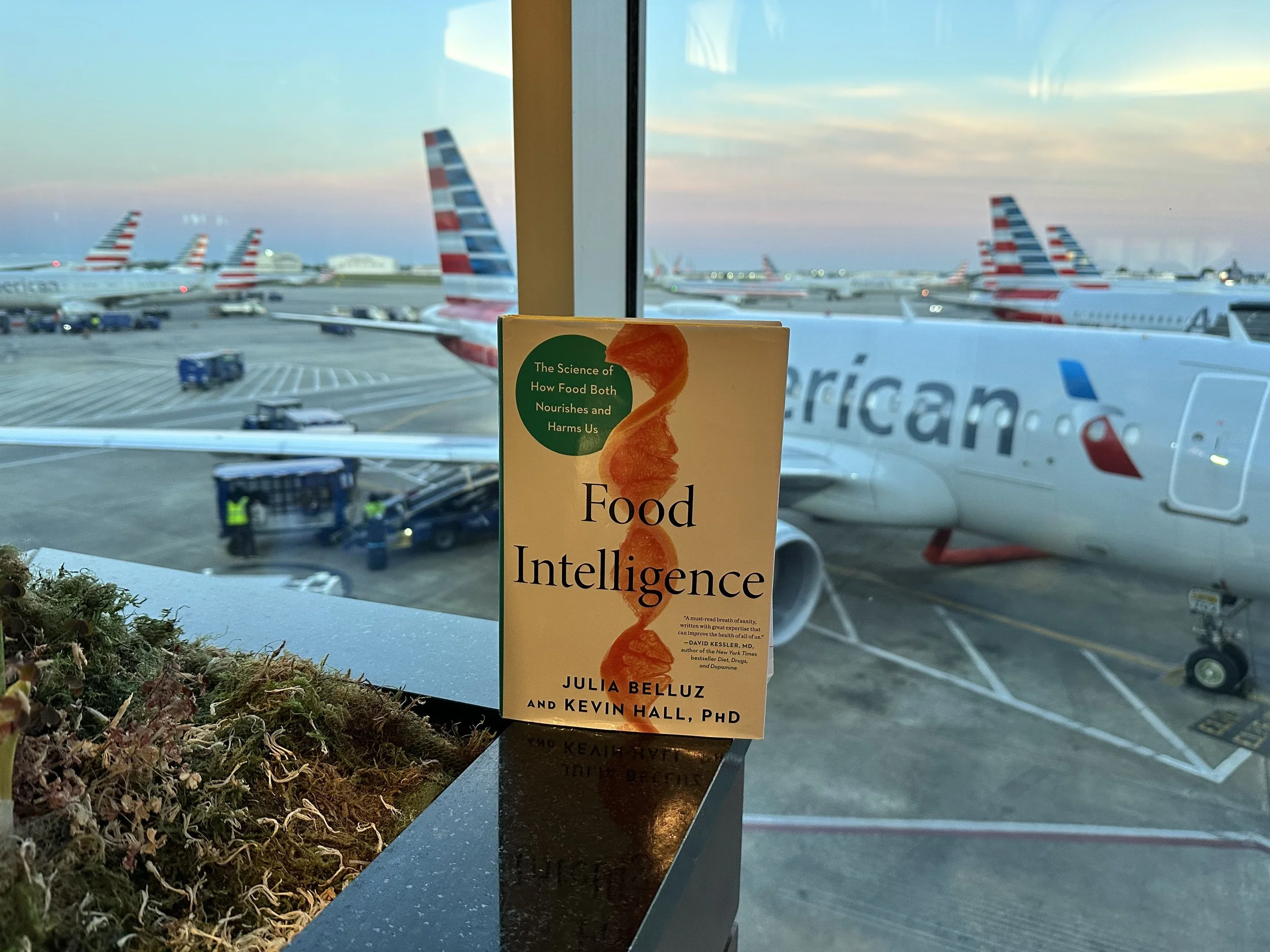
While traveling to North Carolina and away from the daily grind of work, I was finally able to read a book—a miracle in itself! I chose Food Intelligence, co-authored by Kevin Hall and Julia Belluz. The fact that the book is written equally by both takes a bit of getting used to, especially since they use the third person when referring to themselves. I am not sure it totally works, but I am also not sure how else one would co-author such a book.
The book is incredibly informative, particularly regarding Dr. Kevin Hall’s research. Hall is a biophysicist and was a senior investigator at the NIH until 2025. He is renowned for his highly rigorous "metabolic ward" studies, which often house participants in clinical settings where every calorie, movement, and biological secretion is precisely measured.
Kevin spent years at the NIH conducting clinical trials to study metabolism, weight loss, and the impact of specific foods (particularly ultra-processed foods) on body weight. In one of his most famous studies, he found that when people ate ultra-processed foods, they spontaneously consumed about 500 extra calories per day and gained weight. Conversely, when on an unprocessed diet, they lost weight. He argues that the energy density and hyper-palatability of these foods—driven by the processing itself—trigger weight gain, rather than just "too many carbs" or "too many fats."
In fact, he has conducted trials comparing low-carb and low-fat diets, finding that a low-fat diet actually resulted in slightly more body fat loss than an equal-calorie ketogenic diet. In essence, "a calorie is a calorie" is a fairly accurate rule. However, he notes that the old "3,500-calorie deficit equals one pound of weight loss" rule is not linear. He also studied contestants from The Biggest Loser and showed that, even years after the show, their metabolisms had slowed significantly more than expected for their new body size. This "metabolic adaptation" (or "starvation response") persisted even when they regained the weight.
His departure from the NIH (which clearly happened after the book was published) was highly publicized and controversial, as he cited a breakdown in scientific integrity and political interference as his primary reasons for leaving. It sounded like he was in the middle of several trials at the time, which is a real shame for the field.
While the book is an excellent primer on metabolism, I wish it had tackled GLP-1 drugs head-on. These medications are the "missing link" for much of Hall’s research. By mimicking natural hormones, drugs like Ozempic and Mounjaro do three things:
Mute "Food Noise": They signal the hypothalamus to dampen the brain's reward centers.
Slow Digestion: They delay gastric emptying, so you feel full longer.
Stabilize Blood Sugar: They manage insulin and glucagon to prevent the spikes that drive hunger.
This leads to a natural calorie deficit and—most importantly—a shift away from the ultra-processed foods Hall spent his career studying.
The authors lean heavily into the "toxic food environment" theory—the idea that our system, not our willpower, is the problem. I agree 100%. But it leaves me wondering: if we "solve" the hunger signal with a pill, will we still have the political will to fix the food system? Or will fixing the environment become a non-issue once the price of these drugs drops? We are in the middle of a massive "live experiment."
In the final chapters, they pivot to the wider food system. I was interested to see how a biophysicist and a journalist would frame the food system’s contribution to nutrition and metabolism. While they got the big picture right, the analysis felt a bit shallow. It didn't feel like it added much to the book's core value, and they seemed to throw softballs at potential solutions to the issues Kevin witnessed and analyzed during his trials.
Overall, Food Intelligence is a truly interesting read about the state of weight-loss research.