
Food Bytes: June 2026 Edition

Here we are. Smack dab in the middle of Europe’s second heat wave here in Bologna. My years of living in Tucson with a swamp cooler and in NY without any AC have trained my body well, but as the years go on, tolerating the heat gets a wee bit harder. According to Rothko, we are Orange, Red, Orange, 1961. I’ll take that and fester in it for a while. But in all seriousness, the world keeps signaling to us that something is off. This “Omega heat dome,” where Europe remains ill-prepared, is the latest example. The Po is drying up, which is bad for agriculture. A high-pressure system has trapped hot air over South Asia, creating a prolonged heatwave. Wildfires are poppin in America’s west and Europe’s east. Already, the heat is putting pressure on food supplies (good article on Bloomberg) along with Trump’s unnecessary war with Iran.

And now, we see the World Meteorological Organization has confirmed the rapid development of a new El Niño cycle in the Pacific Ocean. Meteorologists note it is already beginning to shift global moisture and temperature baselines, setting the stage for a highly volatile summer. The Grist has a timely article on the potential impacts the world is likely to see. Data suggest that in South Asia, and India in particular, El Niño weakens the seasonal monsoons, and because India is the world's largest rice exporter, a failed or weak monsoon could severely diminish rice yields and trigger global export restrictions or bans. In Southern Africa, the pattern typically brings hotter, much drier conditions, threatening staple crops like maize and risking a spike in regional malnutrition. While parts of South America (like Peru) face heavy rain and flooding that can wipe out infrastructure, the southern United States is projected to face a much wetter-than-normal year, risking crop-destroying floods from California to the East Coast.

As I always ask my students when discussing extreme events, is the world ready?

With all this heat, it does get hard to sit in front of one’s computer, plunk down on the couch, and read, but on the other hand, it is hard to do much else. So herein lies what I have been reading for the last month. Got through about 4 books so far (see picture on the left). My goal is to read 10 books over the summer months. I have provided reviews of these here, here, and here. All are good reads, with only one related to food. I haven’t had a chance to review Rebecca Solnit’s A Field Guide to Getting Lost, but she certainly captures me not only in her writing but also in how she positions herself in the world. Some say she is the modern Joan Didion. I say she is solely Rebecca Solnit.

Bored? Try this FoodGuesser which gives you a dish or food and you have to guess where it is from. Today’s was surf ‘n turf. Uhhhh…..who else would be so decadent to both steak and lobster on one plate…

Beyond books, I found some of these reports and papers worth some time digging into:

First up, the Global Nutrition Report. It was nice to see a full report again after several years of getting lost in goal tracking that didn’t seem to track all that much…The findings of the 2026 Global Nutrition Report land at a critical juncture, providing a necessary, evidence-based framework for navigating the intersection of climate change and malnutrition. It tells us plainly that our celebrated 'win-win' development narratives are often illusions on the ground. As we shift towards integrated, climate-resilient approaches, the report rightly emphasizes that our policy choices can no longer be treated as separate, single-sector decisions. The 2026 Global Nutrition Report lands not as a comfortable endorsement of ongoing efforts, but as an intellectual disruption to our collective “siloed complacency” and the seductive trap of "win-win" developmental narratives. For too long, the multilateral system has acknowledged the intersections of climate, health, and nutrition only implicitly—treating them as adjacent portfolios rather than as a single, co-dependent polycrisis.

The Global Justice Report (lots of “globals” here)…is a really important report led by the World Inequality Lab. The report outlines a roadmap spanning from 2026 to 2100 that aims to reconcile global economic prosperity with planetary boundaries. The report argues that climate survival and deep decarbonization are impossible without a drastic reduction in wealth inequality. It proposes radical systemic changes—such as a massive "Global Justice Fund" financed by heavy taxes on billionaires, a transition to a two-and-a-half-day work week (YES!!!!), and reduced material and red meat consumption—with the goal of capping global warming at 1.8°C while doubling the incomes of 89% of the world's population. Thomas Piketty, the world-renowned French economist and author of Capital in the Twenty-First Century, brings his trademark expertise in wealth and income inequality to the project. It is dreamy and bold, and worth a read of a utopian world that seems very far off at the moment…

On reports, and this one doesn’t have “global” in the title, is the At the Crossroads: Food in an Age of Uncertainty by Systemiq. This is an interesting report that conducts a foresight analysis (see figure below) of how escalating geopolitical fractures, climate volatility, and artificial intelligence are converging to disrupt the global food system. The report is highly effective at diagnosing system vulnerabilities—notably exposing concentrated supply risks, such as the fact that just four crops occupy 50% of global cropland and that a staggering 30% of global fertilizer trade passes through a single chokepoint, the Strait of Hormuz (a very timely notion indeed). Critically, however, the report functions more as an academic exercise in "futures thinking" than a concrete action plan. While it sharply rejects simple "system efficiency" in favor of holistic structural resilience and issues urgent warnings about ultra-processed food addiction, its conclusions call for "honest dialogue" and "step-changes in global coordination" rather than outlining enforceable regulatory mechanisms or specific corporate mandates. Ultimately, it serves as an excellent diagnostic tool for identifying systemic risk, but it soft-pedals the aggressive, legally binding political battles of food policy and systems.

Stylized scenarios and trends, Systemiq

Some other good peer review articles that I came across:

  • The long and winding road of stunting reduction since the 19th century (P.S. that is not the name of the article…). Some good lessons for LMICs still dealing with stubbornly high stunting prevalence, particularly from Japan.

  • Was the Lancet series on ultra-processed foods not sufficient? Well, AJPH has you covered with a whopper of a special issue on UPFs and public health. If you don’t have time to read the 18 articles, you can read Lindsay Smith Tallie and Ashley Gearheardt’s summary on their new Substack, Unjunked, to get the highlights, or this NYT article. If you want to see what to do about it, get involved with Fedup! movement.

  • The WHO has published its estimates on the hazards of foodborne illnesses. The results are scary, and I don’t think the global food system community talks enough about food safety. They show that as of 2021, foodborne transmission of the 42 hazards they studied caused 866 million illnesses and 1.52 million deaths. Of those hazards, inorganic arsenic, lead, and non-typhoidal Salmonella enterica caused the most damage, particularly among young children and in Africa and South-East Asia.

  • A review of countries worldwide shows that 64 have implemented sugar-sweetened beverage taxes, covering 3·. billion people, with Asia leading the way.

  • Love this paper, which links the lack of clean drinking water to food insecurity (and vice versa) and to food safety issues. Good read!

  • A timely paper understanding the impacts of trade on the water-energy-food (WEF) nexus. In the paper, they construct WEF networks to quantify trade-driven changes. High-income countries achieve stronger WEF synergies that promote gains across all three aspects, whereas low-income countries face many trade-offs, with food-centered competition over water and energy driving them. This is why I always argue for the “energy bros” out there to consider food…

  • While not food-related, an important read on how “commitments to stronger international cooperation are being strained by rising authoritarianism, weakening multilateralism, aid cuts, and growing misinformation” when it comes to infectious disease spread (with the recent cases of Hantavirus and Ebola). These same issues will hinder efforts to address food insecurity and malnutrition. 

  • The Johns Hopkins Center for Humanitarian Health–Lancet Commission on health, conflict, and forced displacement: health in a world of crises and impunity outlines a comprehensive strategy to reform the global humanitarian system amid escalating modern crises (see Figure below) by demanding an end to legal impunity, a total inversion of power toward localized decision-making, and a complete restructuring of how emergency health funding is distributed to affected populations. Boom.

Timeline of humanitarian health crises, reforms and milestones, 1863–2025 (Spiegel et al 2026)

Some other tidbits and interesting reads across media:

  • Who knew ranch dressing would be popular?

  • I was just visiting London and Brighton, and yes, I had fish and chips goddammit. But is England ready to move away from cod? Bloody hell!

  • A wonderfully philosophical long read in the Guardian about whether ecosystems can malfunction, in which the author argues that ecosystems only "malfunction" when humans co-opt them for specific goals.

  • Innovation on how to run a restaurant (don’t charge for food) in Minneapolis (we got your back, friends!).

  • The Economist argues that feeding the world will require new technology. Um, Duh! But is AI the game-changer? I remain skeptical.

  • What have we learned about GLP meds? It’s the wild, wild west, ya’ll! But clearly, this may prove to be a game-changer in tackling obesity.

Well, my hands are starting to sweat, making it hard to type. I will leave you an album that came to mind recently and that I had not listened to in a good long time: the self-titled Violent Femmes album that came out in ‘83 in my junior high days. The Violent Femmes are an American folk-punk band from Wisconsin. Such an original sound at the time. We were kind of obsessed with this album for a hot minute, and somehow, it fits with summer, the heat, frustration, etc. A funny side story: the group was busking in Milwaukee on a street corner, and the guitar player for the Pretenders happened to be walking by, heard them, and invited them to open for their show that night. Hot damn!

Food Bytes: January 2025 Edition

FOOD BYTES IS A (ALMOST) MONTHLY BLOG POST OF “NIBBLES” ON ALL THINGS CLIMATE, FOOD, NUTRITION SCIENCE, POLICY, AND CULTURE.

Here in NYC, we are settling into a deep freeze. I sort of like it. The air is a bit more electric and crisper. Clean. Silent. And when the sun shallowly crosses over the landscape and warms you up a tad, you feel so grateful. For those of you, dear readers, who know how this archiver spends her time, I eat a lot of clams (note the header change on the Food Archive). This time of the year has some of the best bivalve eating. This archiver also spends time with her better half making dark and sad music as part of the Sound Furies. It seems that with each passing year, we get less and less snow on the East Coast. It reminds me of this tune we recorded in 2019, but my better half wrote the lyrics when he was young, living in northern California., sleeping in his ‘67 mustang.

last night it snowed though it's almost summer
it hasn't snowed here for 6 yrs
maybe it was the silence, like a blanket in the night
we don't know why we had this dream

Enough pontifications about weather and clams. Let’s get into this month’s Food Bytes. I always like to start the monthly round-up with a few recommended books I have been reading. Here we go. An Immense World by Ed Yong is a fascinating view of how animals perceive the world through their specialized and adaptive senses. Douglas Brinkley’s whopping 600-page read, Silent Spring Revolution, provides a historical deep dive into the beginnings of the environmental movement in the United States in the 1960s. He articulates how presidents and scientists charted a course for protecting the environment (it is my background homework for a book I am working on that I allude to here). This was a time when presidents were presidential (yes, even Tricky Dick is looking good compared to what we are dealing with now…) and worked to preserve the planet instead of watching it all burn. Delano by John Dunne (Joan Didion’s husband) is about the California grape strike led by Cesar Chavez and his sacrifices to ensure that migrant laborers get a fair shake. Again, this book is incredibly timely with the present-day shifts in U.S. “policies” to deport immigrants—the very same people who are keeping us well fed and food secure. And last is Rachel Kurshner’s short story collection, The Hard Crowd. She just oozes cool.

Book reading by the food archiver

Food and cooking

There has been a deluge of articles and media attention on ultra-processed foods. Let’s start with that and then get into real food stories.

The change in attribution of sugar-sweetened beverages to diabetes (T2D) and heart disease (CVD) incidence across regions from 1990 to 2020.

  • Ah the lovely world of ultra-processed foods (UPFs). These foods are high in sugars, salts, or unhealthy fats and have additional ingredients such as additives, preservatives, and many other hard-to-pronounce ingredients that make them taste good and allow them to sit on shelves for decades. Many scientific articles are trying to attribute UPFs to various deleterious health outcomes, and the evidence, while varying in quality, is building. Enough so that policymakers are taking note. Research suggests that almost 60% of the American diet comprises these foods. Yum. The New Yorker put out an article trying to understand why that is. It is a good read that tries to unpack the evidence. One thing that comes up is that not all scientists agree on the impacts of UPFs on health.

  • A Nature Food article delves into how governments have responded to regulating UPFs. Most government action has been on consumer education, mainly labeling food products rather than eliminating or regulating the companies that make these foods.

  • It is not only foods we are talking about. There are also ultra-processed beverages. Using the Global Dietary Database, this Nature Medicine paper shows that in 2020, 2.2 million new diabetes cases and 1.2 million heart disease cases were attributable to sugar-sweetened beverages worldwide. Between 1990 and 2020, the most significant increased attribution of these drinks to diabetes and heart disease was in sub-Saharan Africa! However, sales of these beverages, particularly soda, are rising (see the figure to the right). Great…

  • Onto real foods. I highly recommend this New Yorker article on the secret history of risotto and the rules that govern how to make this delicious dish whose origins sit on the Po River (a river very constrained by climate change).

  • Speaking of iconic foods and their origins, those who have lived in NYC for decades likely remember this Indian restaurant enclave in the East Village. You know, the one with all the Christmas lights. Well, in typical warp-speed fashion and the brutal world of restaurant ownership in this city, the Indian restaurant hubs have moved to other parts of Manhattan and, more so, Queens. But still, this one restaurant in the village keeps shining on. Funny enough, my former college roommate lived above this place in the late ‘90s. It is (not)safe to say she had a roach problem.

  • Then we have tortillas. I wish we had a tortilleria in our hood, but alas, we have to buy the Mission brand tortillas, which taste like cardboard. As this article in the Atlantic suggests, they have lost their magic.

  • Last, but not squarely in food, the Lancet published a commission to find ways to measure obesity better. With all the kicked-up controversy regarding body mass index as a sufficient measurement tool to delineate overweight and obesity, it’s good timing. Here is a nice infographic that summarizes their recommended diagnostic.

Climate change

Let’s move on to a lighter topic: climate change! In all seriousness, we are in a scary time. This past year, 2024, was the warmest year on record, and the average global temperature was more than 1.5°C above pre-industrial levels for the first time, with 11 months of the year exceeding 1.5°C. To make matters worse, the current U.S. administration has pulled out of the climate accord and plans to “drill baby drill.” This trend and these political decisions fuel our motivation to fight the good fight and ensure the world moves towards mitigation and adaptation solutions, with or without the United States.

  • The Economist published a well-balanced article on the potential and limits of technology to mitigate climate change through the livestock sector. It is nice to see the International Livestock Research Institute’s work (based in Kenya and Ethiopia) highlighted—who partner with some of the poorest in the world who are tending to animals for their livelihoods.

  • One issue is to ensure that those countries and populations struggling with undernutrition still have options and choices to consume animal-source foods, particularly in places where access is incredibly and unfairly limited. The Netherlands Working Group on International Nutrition and Clim-Eat put out a brief on animal-source foods in low- and middle-income countries that nicely summarizes the broad evidence. My only gripe is that they should cite the original peer-reviewed publications and evidence toiled over by scientists as opposed to the reports that summarize the said evidence.

  • Grist, a fantastic climate/environment/food reporting outfit, wrote a worrisome article about how many farmers and farm workers now need to work at night due to extreme heat. conditions Farming is already hard enough, and now this.

  • Speaking of great journalism, Civil Eats has summarized a set of articles of their “best climate reporting” of 2024. Check it out.

  • I have lots of time and space for Kyle Davis’s work. In this paper in Science Advances, he and colleagues use high-resolution data on forest cover in Nigeria and find that 25 to 31% of annual forest loss is linked to climate variability. They also find that changes to forest cover have positive associations with dietary diversity, whereas cropland expansion does not. There is much to think about adaptation-wise regarding how the world manages land and forestscapes.

  • I always have to throw in a critique of the EAT-Lancet Commission. In this paper by Klapp and colleagues published in the Lancet Planetary Health, they articulate a justified framework of shortcomings (see figure below) that the Commission did not address in the first report in 2019 with the hope that these issues will be taken up by the Commission when the 2nd report comes out in the fall of 2025. What I can say at this stage, Anna-Lena, is that we cover some, but not all, of these crucial issues. It looks like a third Commission may be in order!

Current shortfalls of the planetary health diet from a plant-forward perspective by Klapp et al, LPH 2025

Food Systems and Farming

Alignment between food system transformation and degrowth

  • This paper in Nature Food by Matt Gibson and some of my favorite colleagues Constanza, Daniel, and Mario (yay, Cornell!) presents a fantastic notion that in the political momentum that we must “transform our food systems,” there is also this notion that we have also to consider downscaling of excess production and consumption among high-income countries and overconsuming individuals. The figure to the right shows the alignment (or misalignment) between the goals and objectives of degrowth and food systems transformation.

  • But some argue that big farms don’t need a lot of transformation and should stay the course of how they are being managed. This article ruffled a lot of feathers. The title, “Sorry, but this the future of farming,” is snarky and reeks of know-it-allism. Anyone who comes to the farming conversation as having THE solution is suspect. This article is the last in the NYT’s series on “What to Eat on a Burning Planet” — a mix of low and high-quality articles with some half-truths. Go to the bottom of this article to see the series.

  • Let’s get to some farming articles. This paper in Nature Communications argues for the importance of including genomics research and development of what are called underutilized crops, but also called neglected crops or opportunity crops—into breeding strategies, cutting-edge research, capacity building, and representation that some major crops like maize, rice and what get.

  • A slew of experts published this paper in Nature Food to highlight the importance of small-scale fisheries (SSF). In this mapping exercise, they estimate that SSF provides 40% of the global seafood catch worldwide. This 40% provides roughly 2 billion people with 20% of their dietary intake of six crucial micronutrients. Half of these SSF are women, and many are employed in Asia. Africa supplies the largest catch. This is a fantastic article for those interested in blue foods.

  • I love this Soil Atlas that comes out each year by the Heinrich Boil Stitlung/EU. This report is chock-full of great case studies and figures arguing for better care and management of soils worldwide to promote resilient agriculture and mitigation of climate change. Called the global silent crisis,” 1/3 of soils are degraded globally, and 40% of those soils reside in Africa.

Self-promotion (sorry!)

I always have to be a bit self-promotional. The Food Systems Countdown Initiative (FSCI) has published its third annual paper in Nature Food and Policy Report. The highlights?

The FSCI interactive tool on the Food Systems Dashboard

  • Over the past two decades, meaningful progress has been made in improving food systems. Of the 42 indicators examined, slightly fewer than half (20) changed in a desirable direction from 2000 to 2022.

  • Most of the FSCI tracked food system indicators interact with other indicators, either directly or indirectly, meaning that change in any one area of food systems is likely to affect others and that unlocking change may require coordinated action across multiple dimensions.

  • Certain indicators related to governance and resilience are key leverage points — and could be critical because of their influence and dependence on other aspects of food systems, and change in them can affect many other indicators.

One cool thing we did was put the indicators and their interactions on the Food Systems Dashboard. You can play with the FSCI data in all kinds of ways. To get yourself oriented, you can find the indicators here, all the data globally and by country, the country profiles of the FSCI data (for example, Kenya), and last, the interaction tool (which is pretty neat).

We’re screwed, but some more than others. And that is not fair…

  • The scary annual World Risk Report just came out and it just got a bit scarier this year. Gee, I wonder why…we are so screwed.

  • Reuters published a heartbreaking collection of journalism entitled “Starving World.” Just devastating but worth taking the time to read.

  • With avian flu sparking and spreading, this article in Nature Reviews Biodiversity is a warning call about pathogens and planetary change.

Food Bytes: March 2023 Edition

FOOD BYTES IS A (Almost) MONTHLY BLOG POST OF “NIBBLES” ON ALL THINGS CLIMATE, FOOD, NUTRITION SCIENCE, POLICY, AND CULTURE.

So much going on in food and nutrition these days that it is hard to keep up. In looking at what has been published in the last month, three areas dominate ultra-processed foods, climate change, and blue foods. Let’s take each and highlight the latest and the greatest.

Ultra-processed foods: What are ultra-processed foods (UPFs), may you ask? Basically, junk food. But we scientists have to come up with fancy terms and categorize everything. UPFs are a very broad category of foods that generally are made from highly processed, industrialized ingredients not found in the home or in restaurant kitchens. These foods are designed to be hyper-palatable, often conveniently ready-to-eat, shelf-stable, transportable, strongly marketed, and, ultimately, highly profitable. More and more research shows that these foods are detrimental to various health outcomes (obesity, diabetes, cancer, morbidity, mental health, etc.) and could be potentially addictive and environmentally destructive. California, which always leads in food governance (blame it on the hippies), is growing worried about what exactly these foods contain. They are considering banning a number of staple ingredients found in these foods. I cannot even begin to source the sheer amount of literature coming out demonstrating the impact of these devilish foods, but here, here, and here are a few good systematic or meta-reviews. This Wired layperson article is a good summary. If you want to read two people who lead in the science of UPFs, read Carlo Montiero or Kevin Hall. Regardless of all the science coming out, their sales are increasing across almost every region of the world. Why? Well, they are cheap, have a long shelf life, are easily stored and transported for long periods of time, and are damn tasty.

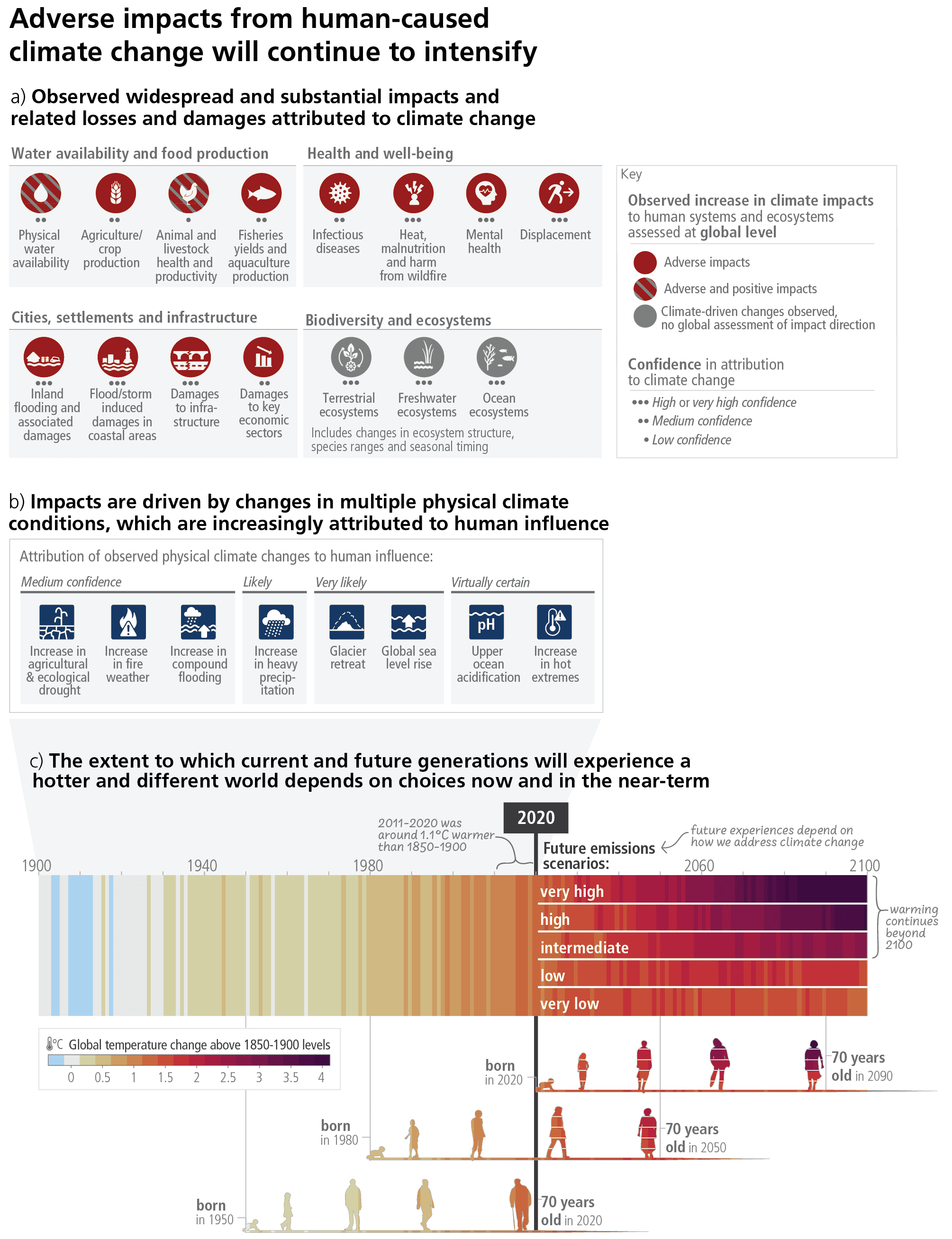
IPCC AR6 Synthesis Report, 2023: Key Summary Figure

Climate and food: Hard too to keep up with everything going on. The most significant update is that the Intergovernmental Panel on Climate Change, also known as the IPCC, has come out with a synthesis report on how much time we have left before the world falls apart. They are surprisingly and cautiously optimistic, arguing that there is still time to address climate change before things start “gettin’ hot in here.” Food is heavily featured in this synthesis report, thanks to our AgMIP friends at Columbia University. They argue that food security and nutrition are and will continue to be significantly impacted, particularly in resource-constrained settings and among smallholder farmers. They also offer a range of mitigation and adaptation strategies, including agriculture, forestry, and other land use (AFOLU) options with reduced deforestation in tropical regions, shifting to sustainable healthy diets, reducing food loss/waste and intensifying sustainable agriculture (they even mention urban ag!).

When I asked Google’s new AI system, Bard, what was the latest science published in “food systems” in the last week, this is what they spit out:

Here are some recent research on food systems:

  • A new study found that the global food system is responsible for about one-third of all greenhouse gas emissions. The study, published in the journal Nature, found that the food system's emissions are mainly caused by the production of meat and dairy products, as well as the transportation of food.

  • A new study found that the global food system is also responsible for about one-third of all water use. The study, published in the journal Nature Water, found that the food system's water use is mainly caused by the irrigation of crops, as well as the production of meat and dairy products.

  • A new study found that the global food system is also responsible for about one-third of all land use. The study, published in the journal Nature Land, found that the food system's land use is mainly caused by the production of crops, as well as the grazing of livestock.

These are just a few of the recent research on the global food system's impacts on the environment. The food system is a major contributor to climate change, water pollution, and land degradation. These impacts are likely to become more severe in the coming years, as the global population continues to grow.

Not too shabby, but a bit outdated (and they don’t provide any citations). Interesting how AI is set to become such a game-changer, and yet, as an expert, asking Bard to do a bit of research, it is pretty generic and lacks scientific nuance, which can be dangerous…Here are some even more recent papers out this week on food systems and climate from a flawed human perspective:

  • Ivanovich and colleagues at Columbia University (see a pattern?) published a paper in Nature showing that if we continue on our current food consumption patterns, this will add 1 °C to an already warm planet by 2100. Most of this warming is driven by what is called high methane foods (methane is another toxic greenhouse gas) like livestock, dairy, and rice (yes, we cannot blame it all on those cute cow creatures). If we made some of the changes mentioned in the IPCC report above, we could cut 55% of that warming.

  • Another paper, again published by Columbia University peeps (they are on a roll), called for more studies to better show how the food security of households and communities is impacted by climate-related shocks. They argue that most studies only examine food production and availability, not access or utilization.

  • And last, and this is self-promotional, a few of us put together an analysis trying to understand if the EAT-Lancet planetary health diet was adequate in nutrients (we didn’t look at environmental impacts or other health impacts, and we are not suggesting to do so). This particular analysis shows that the diet is inadequate in vitamin B12, calcium, iron, and zinc. The EAT-Lancet may not be happy with these results but this is what science is all about — debating on a level playing field, DISproving one’s hypotheses, and not being wed to ideologies. I am not sure right now that everyone at the so-called proverbial table looks at science similarly and instead holds fast to their worldviews, which worries me. But a lot is at “steak.” The EAT-Lancet Commission part has been downloaded over 6,000 times in 4 years. That is pretty insane. So to go against that, dissect it, calls to do it better next time around, or at least look carefully at the data, in which multiple people analyzing the dataset, is, well, what science and the pursuit of truth is all about. But putting one’s arm out to be potentially severed. Bottom line: This paper is about the trade-offs that are par for the course with a grand food systems transformation.

Showing tradeo-offs of policy bundles: Crona et al Nature 2023.

Blue foods: More and more, and this is long overdue, blue foods, aka seafood, aka aquatic foods, are getting more attention. The Blue Foods Assessment highlighted their importance from multiple angles - important contributors to a nutritious diet, some species’ environmental sustainability, their risk of climate threats, and contributors to livelihoods. Some fantastic articles have emerged recently, including a fantastic paper by Christina Hicks and colleagues examining the injustices associated with aquatic food systems. Another paper summarized the BFA around 4 policy objectives to help realize the contributions that blue foods can make to national food systems around the world: ensuring supplies of critical nutrients, providing healthy alternatives to terrestrial meat, reducing dietary environmental footprints, and safeguarding blue food contributions to nutrition, just economies and livelihoods under a changing climate. However, trade-offs always exist, just as above. The figure shows these — the question is, what trade-offs are we willing to live with? And last, on blue foods, the great Roz Naylor at Stanford published a policy landscape paper in Food Policy (thanks, Chris Barrett!) on aquaculture. I had the pleasure of working with her on this. Through a series of case studies, she presents a state-of-play on how aquaculture is playing out globally, and again, where those policy priorities elicit trade-offs that can be detrimental to the environment or nutrition. Check it out.