We're excited to share the latest research from the Food Systems Countdown Initiative (FSCI), a global effort we co-chair alongside Lawrence Haddad of GAIN, Mario Herrero of Cornell University, and José Rosero Moncayo of FAO. For those unfamiliar with our work, the FSCI is a collaborative research initiative that brings together experts from every major world region, spanning academia, UN agencies, and civil society, all united around a single mission: to monitor whether the world's food systems are actually moving toward being healthier, more sustainable, and more equitable. Since our founding, we've tracked 50 core indicators across five themes—diets and nutrition, environment and production, livelihoods and equity, governance, and resilience—publishing annual reports that aim to hold governments and institutions accountable to the promises made at events like the 2021 UN Food Systems Summit. You can learn more about our full initiative, our team, and our history here.
This year's flagship analysis, published in Nature Food and accompanied by our 2026 policy report, represents a major methodological leap forward for the Countdown. We want to give special thanks to lead author Bianca Carducci, who drove this work from literature review through analysis and drafting, along with the many collaborators who contributed data updates, review, and expertise across our extensive network. In previous years, we could tell you whether an indicator was trending in a good or bad direction, but we couldn't say how good is "good enough."
This year, we fixed that. For 44 of our indicators, we established two types of reference points: targets and benchmarks. Targets are fixed goalposts drawn from existing international commitments, human rights conventions, or theoretical minimums and maximums—things like the SDG commitment to universal access to safe drinking water. Benchmarks, on the other hand, are relative and empirically grounded: for each indicator, we looked at how the best-performing 20% of countries were doing—globally, within their region, and within their income group—and used that as a realistic peer-based standard. This distinction matters because targets tend to be aspirational and often the same for every country, while benchmarks acknowledge that countries face different starting points and constraints, offering a more attainable near-term goal even as we keep our eyes on the bigger, more ambitious targets.
Beyond simply comparing where countries stand today to these reference points, we wanted to understand the pace of change. So we calculated each country's historical rate of progress since roughly 2015, using something called the compound annual growth rate—essentially, how much an indicator would need to change every year, compounding annually, to get from where it is now to where it needs to be. We did this for two future horizons: 2030, the SDG deadline, and 2050, a longer runway that allows for more gradual but sustained improvement. This let us classify countries into categories like "on target," "moderate progress," "marginal progress," "stagnating," or "regressing," and—critically—to calculate exactly how much faster each country or region would need to move to close the gap by each deadline.
So what did we find? The headline result is sobering: of the 30 indicators with global targets, only one—mobile phone subscriptions—has been met, on average, at the global level. For nearly every other indicator, current rates of progress are simply insufficient to hit global targets by 2030. Some indicators aren't just moving too slowly; they're moving in the wrong direction entirely, including civil society participation, agricultural water withdrawal, and food systems emissions. When we ran the numbers on what it would take to close these gaps by 2030, the required annual changes for many regions were, frankly, unattainable—the kind of growth rate that has essentially never been sustained in the real world for that indicator.
But there's a more hopeful part of this story. When we compared countries to regional or income-group benchmarks rather than the more ambitious global targets, performance looked considerably better, since these benchmarks are calibrated to what peer countries have actually achieved. And when we extended our timeline out to 2050 instead of 2030, many targets and benchmarks that looked impossible suddenly became achievable with steady, sustained effort. Vegetable availability is a good example: hitting the benchmark by 2030 would require punishing annual increases in most regions, but by 2050, the necessary pace drops to something far more realistic. The same pattern held for governance indicators like the open budget index and social capital index. This is really the core message of our 2050 pathway: transformation is still possible, but only if we start accelerating now and maintain that momentum without disruption from shocks like funding cuts, conflicts, or pandemics.
Not everything brightens with a longer timeline, however. Food systems emissions change remains a serious outlier—even by 2050, most regions would still need to cut emissions by more than 30% annually to hit the target, an essentially infeasible rate absent transformative policy shifts and investment. Similar infeasibly steep trajectories were required for indicators like child labor, the affordability of a healthy diet, and food price volatility. These are the indicators we believe deserve the most urgent attention from policymakers, donors, and researchers, since business-as-usual trajectories simply will not get us there.
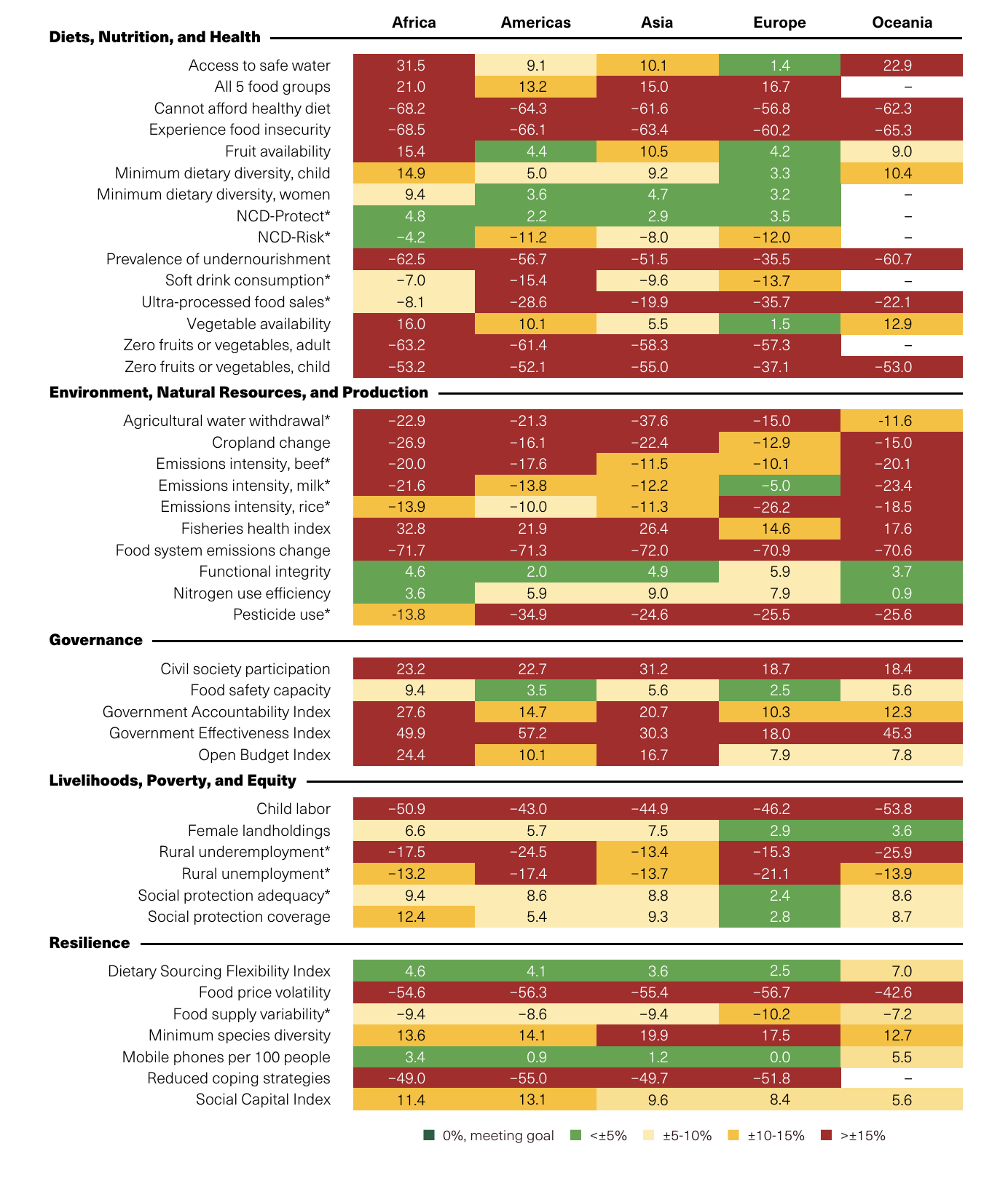
We built this analysis not to be discouraging, but to be useful. Accountability requires knowing not just whether we're moving in the right direction, but whether we're moving fast enough—and our hope is that this target-and-benchmark framework gives governments, funders, and civil society a much sharper tool for prioritizing where investment and policy attention are most urgently needed. We invite you to explore all of the underlying country-level data yourself at the Food Systems Dashboard, where you can see exactly how your country or region stacks up against these targets and benchmarks, both now and on the path to 2050.