The world order is shifting, and not in a good way. Geopolitical tensions, conflict, climate change and growing populism are chipping away at the multilateral cooperation we have relied on to tackle hunger and malnutrition. In my new paper in the Brown Journal of World Affairs, I look at what this means for nutrition, and the picture is sobering. On top of everything else, nutrition has faced massive disinvestment. With the closure of USAID and cuts from Europe, global donations for nutrition programs dropped an estimated 44 percent in 2025 compared to 2022. Osendarp and colleagues estimate this could leave 2.3 million children without treatment for severe acute malnutrition and lead to 369,000 additional child deaths each year.
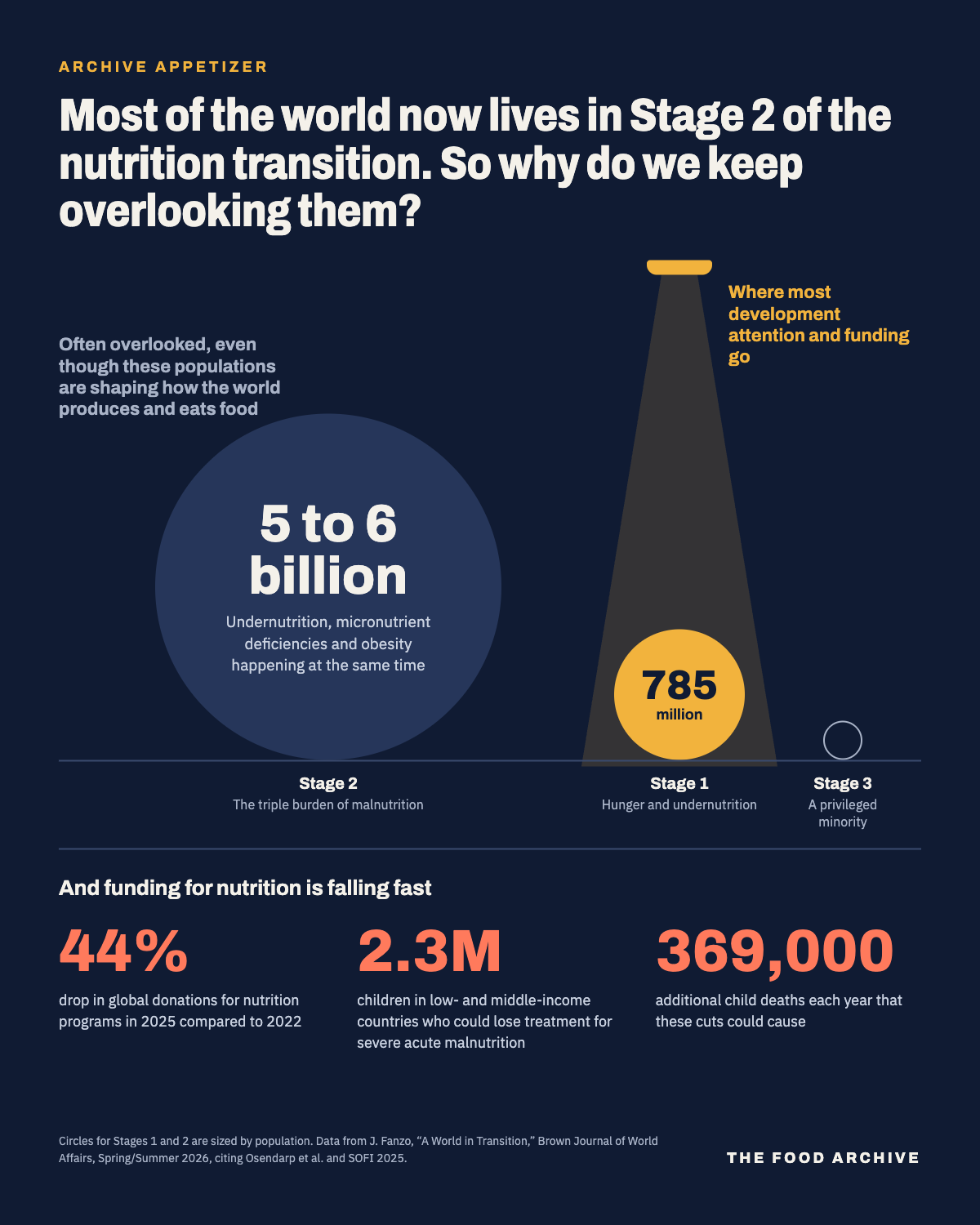
Claude Opus 5.5 made this figure (something I am terrible at…)
I also argue that we need to rethink the “nutrition transition.” The framework was incredibly useful when Barry Popkin developed it around 1990, but food systems have changed a lot since then. Today, most of the world, roughly five to six billion people, lives in what we call Stage 2. These are largely urban populations eating more highly processed foods, moving less, and living longer but with more chronic disease. Countries like India, Indonesia, and South Africa are now dealing with the triple burden of malnutrition, which is undernutrition, micronutrient deficiencies, and obesity all at once. In Indonesia, nearly a third of children under five are undernourished while 38 percent of adults are overweight. Yet the development community has focused most of its attention and money on the roughly 785 million people facing hunger in Stage 1. That matters, of course. But if we keep overlooking Stage 2, we will miss the populations that are shaping the future of our food systems.
Politics sits at the heart of all of this. When governments face unrest, war, or economic shocks, they turn inward, and long-term nutrition goals fall off the agenda. Populist movements are challenging the legitimacy of international institutions and agreements, from the UN to the climate COPs. Sovereignty has become a sticking point too. India and Brazil continue to prioritize their own national food sovereignty over WTO trade rules, sometimes understandably, while the United States has resisted letting the WTO interfere with its “America First” agricultural subsidies. Countries are also setting aside their international commitments in times of crisis, as we have seen with the war in Ukraine and the conflict in the Middle East, both of which have disrupted the movement and prices of food, feed and fertilizer around the world. Even within governments, health, agriculture and education ministries often work in silos, and a change in leadership can unravel nutrition programs that took years to build. Meanwhile, the multilateral organizations we would normally turn to, like the UN, the World Bank and the WTO, are stretched thin and lack consistent leadership. Put simply, the road ahead for multilateral cooperation looks sclerotic, and nutrition is paying the price.
The good news is that we know what works. Mexico's soda tax reduced sales by 12 percent in its first two years, and Chile's warning labels led to a 22 percent drop in sales of labeled foods. The bad news is that collective action is stalling. Of the 127 countries that developed national food systems pathways at the 2021 UN Food Systems Summit, many still have not implemented them. And USAID defunding has disrupted early warning systems like FEWS NET. I am realistic that big global deals are unlikely right now. But countries can still cooperate where feasible, keep food, feed, and fertilizer moving across borders even during conflict, invest in peace and political stability, scale up the many nutrition policies already designed and ready to go, and do a better job of informing the public. When people understand the risks of poor diets, support for policies like food labeling and marketing restrictions reaches 70 to 80 percent. That gives me some hope.