What the world contains

As the summer solstice nears, I feel the tug. The urge. The pressure to do things differently. Read 10 books! Swim every day! Have meeting-less workdays! I scheme in grandiose ways, convinced this will finally be my "summer of quiet," carefully crafting elaborate to-do lists (therein lies problem #1). I tell myself I’ll finally live and work on my own terms, freed from the weekly teaching schedules and the usual semester onslaught. Everyone else is on holiday, right? The emails will slow down…yes?

In one sense, it’s all true. But after fifty-four years on this grand planet, you’d think I would have learned by now. Summers come and go, just like the seasons and the years. And sometimes, they just aren't the summers of your life.

Back in August 2019, I wrote a blog entry titled "Su-Su-Summertime Sadness." In it, I confessed:

“My summers always haunt me. The could’ves, the should’ves, the would’ves. I could have done more with my summer, or I could have done less. I should have done what the Italians do and taken a whole month off to celebrate Ferragosto.”

I even put together a playlist to mark the end of the season, which only succeeded in draining the last of my ambition.

I mean, WTF.

I think this notion of “this is going to be the best summer ever” starts back in elementary school or junior high. Remember those days? Once you finished whatever house and yard chores your mom left for you, the rest of the summer was yours. You went swimming sans sunscreen until your hands were shriveled-up prunes (they were different times, my dear readers). You rode your bike with your amigos down to the 7-Eleven for a Smarties candy necklace, washed it down with a Slurpee, and played kickball into the depths of the night with the neighborhood kids until you couldn’t even see your hand in front of your face.

Total freedom.

We made our own lunches and were entirely on our own. No longer mandated to eat cafeteria school “lunches.” My personal favorite? Campbell’s Cream of Mushroom soup with Lays sour cream and onion potato chips crumbled on top. Variant B was Campbell’s Golden Mushroom soup, sprinkled with Ruffles cheddar-and-sour-cream potato chips. All of it was washed down with a Pepsi and finished off with a Ding Dong or a Ho Ho. Honestly, it is incredible that I am still alive…(don’t hate me Carlos Monteiro!). We were, after all, living that middle-class suburban American life (think 80s: ET, Poltergeist, Sixteen Candles, ya’ll).

I used to beat myself up for not being "productive" enough during the summer. But lately, as some of you know, I’ve been practicing niksen. It’s a Dutch term that means intentionally doing nothing without a purpose or a deadline—just gazing out the window, taking in the scenery, and letting your mind wander. The Italians, of course, have elevated this to an art form.

This art form is known as dolce far niente—the sweetness of doing nothing (Yes, it was popularized by Eat, Pray, Love, but let’s look past that, dear readers). Come summer, they take oziare (to laze about) quite literally. Most of the country shuts down for the entire month of August so everyone can head to the beach, the mountains, or all’estero (abroad) for some R&R. This whole phenomenon is called Ferragosto. Technically, it’s just one official holiday on August 15th. But in true Italian fashion, they looked at one day and thought, “Why not take the whole goddamn month?”

Perché no?

The tradition dates back to 18 BC with the Feriae Augusti, when Emperor Augustus declared a period of rest for agricultural workers. Fast forward a couple of millennia, and it’s still the best excuse on the planet to completely unplug.

I am still working on my niksen (or oziare) skillzzz, but I think I’m finally getting the hang of it. I also promised myself I’d travel less, and boy, have I delivered. One can rarely find Jess Fanzo at a conference anymore. I did make an exception to attend UN Nutrition Week in Rome. I genuinely enjoyed many of the sessions, but my god... the UN really needs to jazz it up. The format is stuck in the past: static panels, formal posturing, dry delivery, and zero audience interaction. The core content is incredibly important, but there has to be a better way to communicate global messages than having a row of people make disconnected, five-minute statements. The irony is that this meeting couldn't have come at a more crucial time. And there were so many fantastic experts in the room who understand deeply how to scale nutrition to the places where it is needed most. Nutrition is chronically underfunded, and global food crises are mounting. Rather than slipping into insular navel-gazing, this forum needs to expand. We need to invite more than just the usual UN crowd and build real, inclusive bridges across different sectors.

From Rome, we took a short trip to visit friends in Napoli—one of our absolute favorite places in Italy, even if the city is beautifully, brilliantly insane. The food alone is worth the chaos. As a pescetarian, Naples is pure heaven. The ultra-fresh mozzarella di bufala that practically weeps when you cut into it, bowls of spaghetti alle vongole packed with local clams, and my god, the wood-fired pizza.

But beneath all that incredible food and vibrant street life, there is a haunting uncertainty to Naples. You can't escape the looming presence of its geology. The entire region sits on a massive, restless volcanic system—from the ominous silhouette of Vesuvius to the steaming, sulfurous bradyseism of the Solfatara craters, constantly reminding you of the earthquakes bubbling just below the surface.
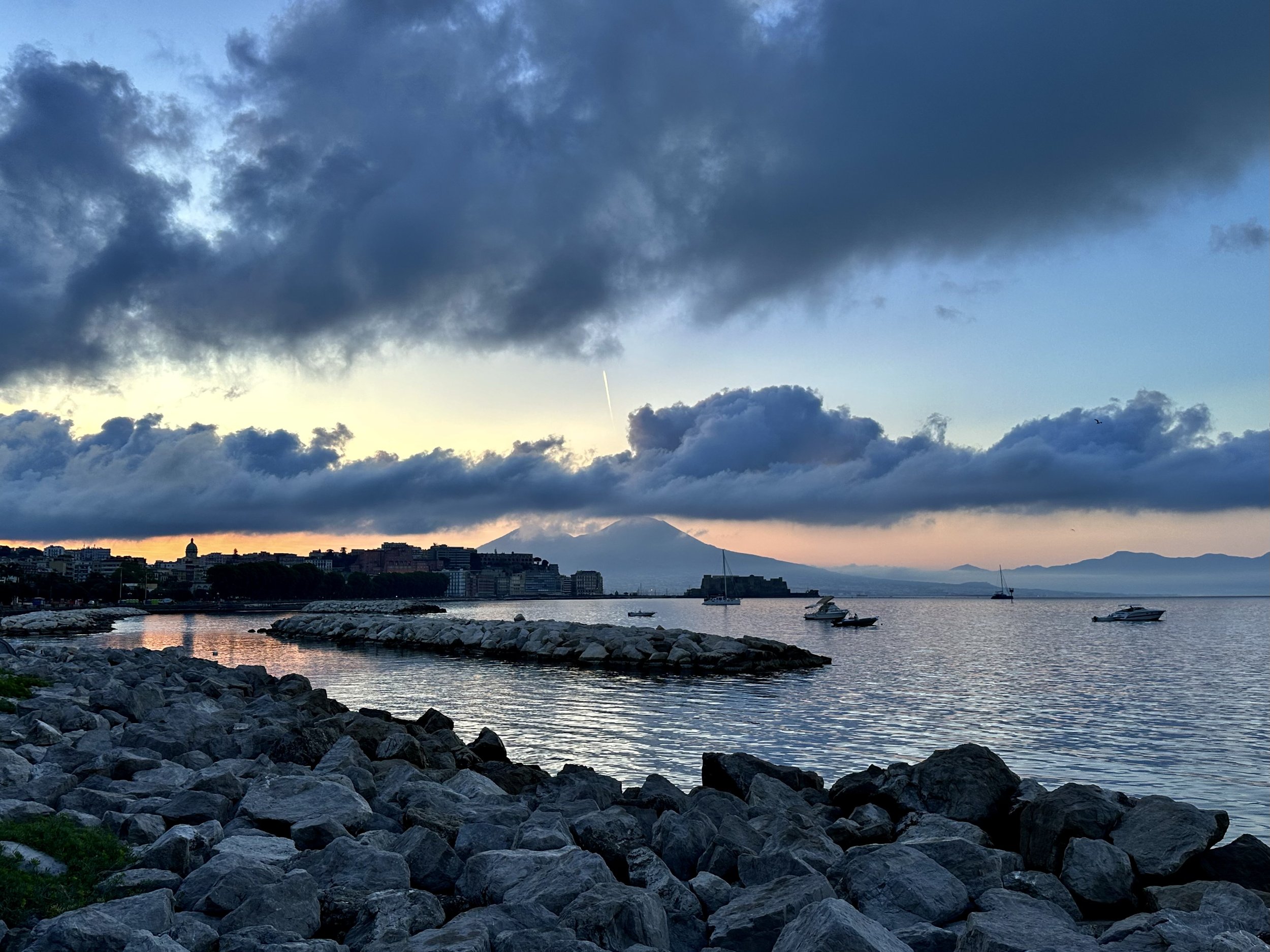
Vesuvius beckons…

While we were there, we watched the gorgeously shot Pompeii Under the Clouds. It’s a film that somehow does nothing but everything all at once—capturing the beautiful, eerie reality of a defiant city that lives, eats, and thrives completely in the shadow of a ticking clock.

..So, remember that ironclad promise I just mentioned about traveling less? Well, the rest of this summer will feature a quick trip to Brighton—to see our good buddy Lawrence Haddad and his family—followed by an Annual Review of Nutrition editorial meeting in London. Then, it's off to Kraków and Warsaw, Poland, for the 10th Annual Conference on Agricultural Statistics. And this year, for the first time, I am actually using up my Ferragosto card — we will spend all of August in Napoli caring for our friends’ place (with a f*#* off view), visiting the islands, amongst the rumbles. And come fall? I am jetting off to much farther-flung places, including Ethiopia and Indonesia. I swear I am still practicing my niksen... I might just have to do it from an airplane seat.

All of these reflections, contradictions, and journeys just leave me thinking about how incredibly lucky I am, how lucky many of us are. And how many of us are not. It is so easy, so privileged for me to say this, right? Particularly in a time when there is so much darkness, so much hate, so much strife in the world. The United States. Gaza, Lebanon, Iran. Sudan. Ethiopia. Ebola. Epstein. The list goes on and on. I recently came across a beautiful piece in The Atlantic written by Alan Lightman, titled "The Ordinary Miracle of Existing." He captures this exact feeling of existential gratitude perfectly:

“Just as our entire planet is a speck in the cosmos, our individual lives are fleeting moments in the grand unfolding of time. And, as the Buddhists always emphasize, everything is impermanent. Everything passes away. The ancient cities of Sumeria and Egypt are long gone, as are the temples of ancient Greece and Rome. Tenochtitlán, the capital of the Aztec empire; Port Royal of Jamaica; the English coastal village of Dunwich. All gone. All that we see around us today will one day be gone. Against this backdrop of history, on Earth and in the cosmos, our individual lives are brief flickers in the chasms of time. It is hard to imagine such a cavernous theater we find ourselves in. But it is even more difficult to fathom how unique each of us is, how improbable, how lucky to be alive at all.”

Striking, isn't it? Especially when you consider how much we try to pack into our brief flickers of summers, of seasons, of well, years. He goes on to note:

“Little by little, we humans gain an understanding of what the world contains. We socialize, we read, we travel, we experience. But, in hindsight, our perspective remains highly limited.”

What the world contains. What the world contains is ultimately a mirror of how we choose to move through it. It forces us to ask: how do we want to live the days we are given? When we realize how small our vantage point truly is, the pressure to "do it all" gives way to a deeper desire to simply live well. It's a humbling reminder as we all head into this summer solstice. We explore as much as we can, we chase the perfect summer, and we try to find moments to simply be. Our perspective is only ever a tiny slice of a massive, beautiful picture—but how lucky we are to get to see it at all.
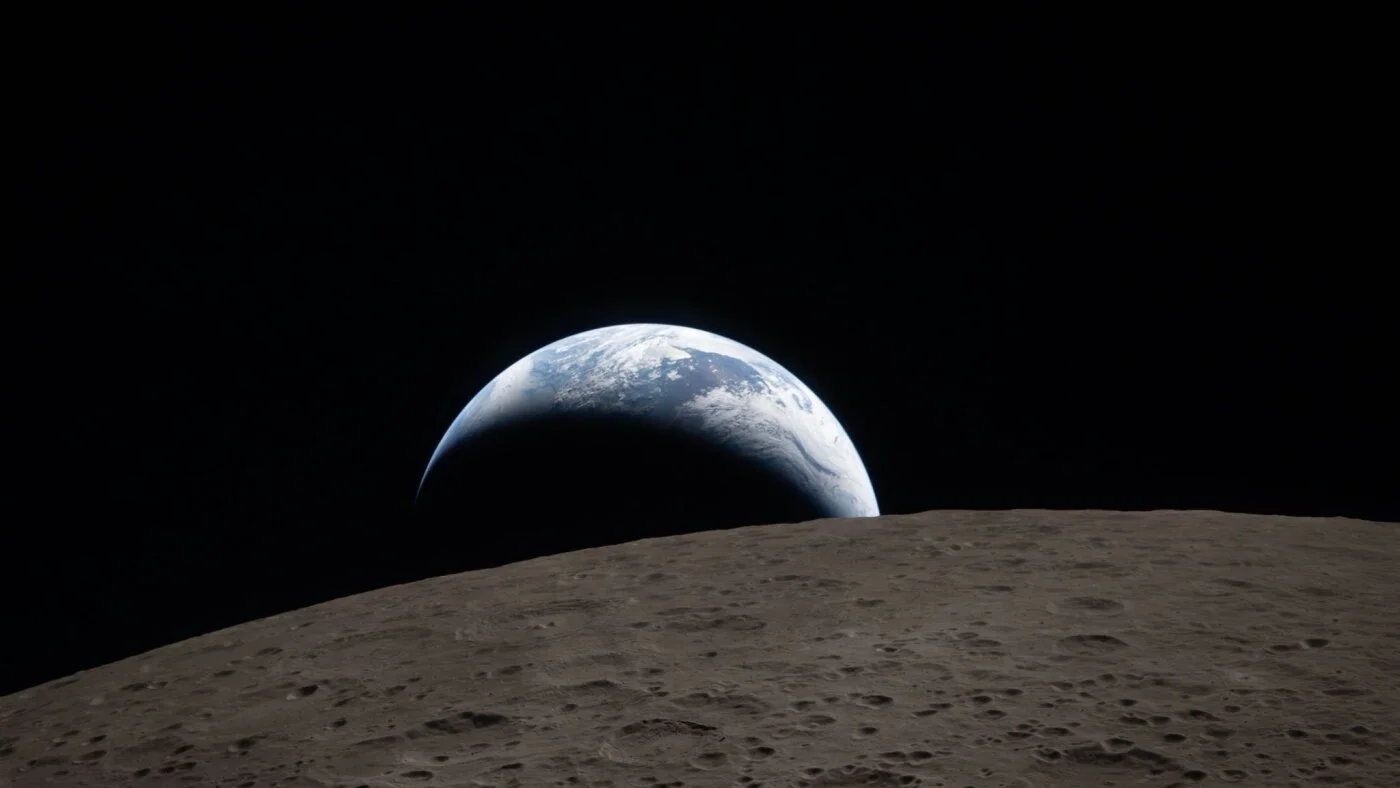
Earthset captured through the Orion spacecraft window at 6:41 p.m. ET on April 6 during the Artemis II crew's flyby of the moon.
From Roman Ruins to Bolognese Bliss

We’ve spent most of late October and November in Italy, preparing for our permanent move to Bologna. Being away from the United States has been refreshing — I catch up on the news less often and with far less emotion. From afar, everything seems a bit bonkers. For anyone feeling overwhelmed by it all, and who has the chance to travel outside the U.S., I highly recommend it. It offers a powerful perspective.

The CFS plenaries largely empty.

Our journey began in Rome with a meeting at the Food and Agriculture Organization, whose building now feels almost impenetrable. I attended the Committee on Food Security (CFS), which was eerily quiet. The current Director General of FAO seems to have shifted focus away from the CFS, scheduling World Food Day a week earlier—a move that, frankly, deflates the committee’s momentum. The sessions were muted, with scant government presence. Even the plenaries were only a quarter full.

Perhaps multilateral cooperation and globalism are truly fading, as Richard Horton recently suggested here and here. We’ll see how the world responds at COP30 in Brazil, tackling the urgent challenge of climate change. Sadly, I agree with a recent New York Times article arguing that governments—not just the U.S.—are turning their backs on climate commitments. There are isolated successes, but the overall climate data is grim. The UN’s annual emissions gap report, “Off Target,” warns that countries are unlikely to keep global warming below 1.5 degrees Celsius, the Paris Agreement’s main goal. Experts predict warming could reach between 2.3 and 2.5 degrees Celsius, or even higher if current pledges aren’t met.

Long lines at Da Enzo

Back to Bella Italia. My partner and I have spent nearly five cumulative years living in Rome. When we first arrived in 2010, those felt like golden years. Tourism was present but manageable, with many hidden gems for eating, drinking, and soaking in the vast cityscape. Today, forget it. Rome has turned into a theme park resembling a mockable Roman empire, swarming with tourists. Even secret spots are overrun by huge lines of people eager to replicate the Instagrammable moments. Our favorite place, Da Enzo, now has block-long lines. We used to pop in spontaneously for carbonara and puntarella. It’s sad—Rome and much of Italy have sold themselves cheaply, like a dollar store bonanza.

After Rome’s disappointment, we went to Napoli to visit friends. The city, too, is suffocating under endless tourists—around 5,000 daily from massive cruise ships—who come to eat pizza, drink spritzes (a drink actually invented in Veneto, northern Italy), and walk the “elephant walk” through Spaccanapoli buying cornicelli charms (little horn-shaped amulets for good luck), all because social media told them to. They don’t really experience the city or stay overnight, retreating to their ships for dinner and sleep. Locals believe tourism boosts the economy, and it probably does—but at what cultural cost? Is this growth sustainable? Naples, too, has given itself away. The New York Times article, “The Spritzes and Carbonaras That Ate Italy,” argues tourism has blanketed the country in a uniform food culture. Maybe not everywhere, but it’s heading that way. Nothing can take away the beauty of these places, but god damn, it is getting hard to see it.

Naples wasn’t all bad, once you are off the beaten path. Walks along and swims in the bay of Naples, insanely delicious pizza and vongole, and a lecture at the University of Naples Federico II Agriculture College were highlights. The College is in a beautiful old royal palace in another part of Naples, called Portici. The palace was built as a summer house for the Spanish viceroys on the slopes of Mount Vesuvius. The college curates a beautiful botanical garden on its grounds. The students and faculty were truly wonderful — they energized me to start teaching this spring in Bologna.

Typical aperitivo for two - and costing less than 8 euros…

From Naples, we took the train north to Bologna, and suddenly it felt dramatically calmer—fewer tourists, more progressive energy. The “Quadrilatero” district, a historic medieval market full of gourmet shops near the main piazza, was surprisingly uncrowded. Bologna is a beautiful city bathed in warm orange and yellow hues, with miles of elegant porticos offering sheltered promenades. The city pulses with the energy of its students—the University of Bologna is Europe’s oldest university. Street art decorates many corners, and the local “aperitivo” culture thrives. Bolognese gather around 6 p.m. for wine, cocktails, and small free snacks (why do potato chips taste so good with sparkling white wine - drats!), with weekends seeing aperitivo start even earlier.

There are downsides. The weather is more like NY, and the air quality ain’t good. But it feels like a progressive, productive city that has a certain gothy, young vibe. Will we be able to sit out on our terrace 365 days a year, ala Rome? No. But would I take this over the tourism hellscape? Hells yah.

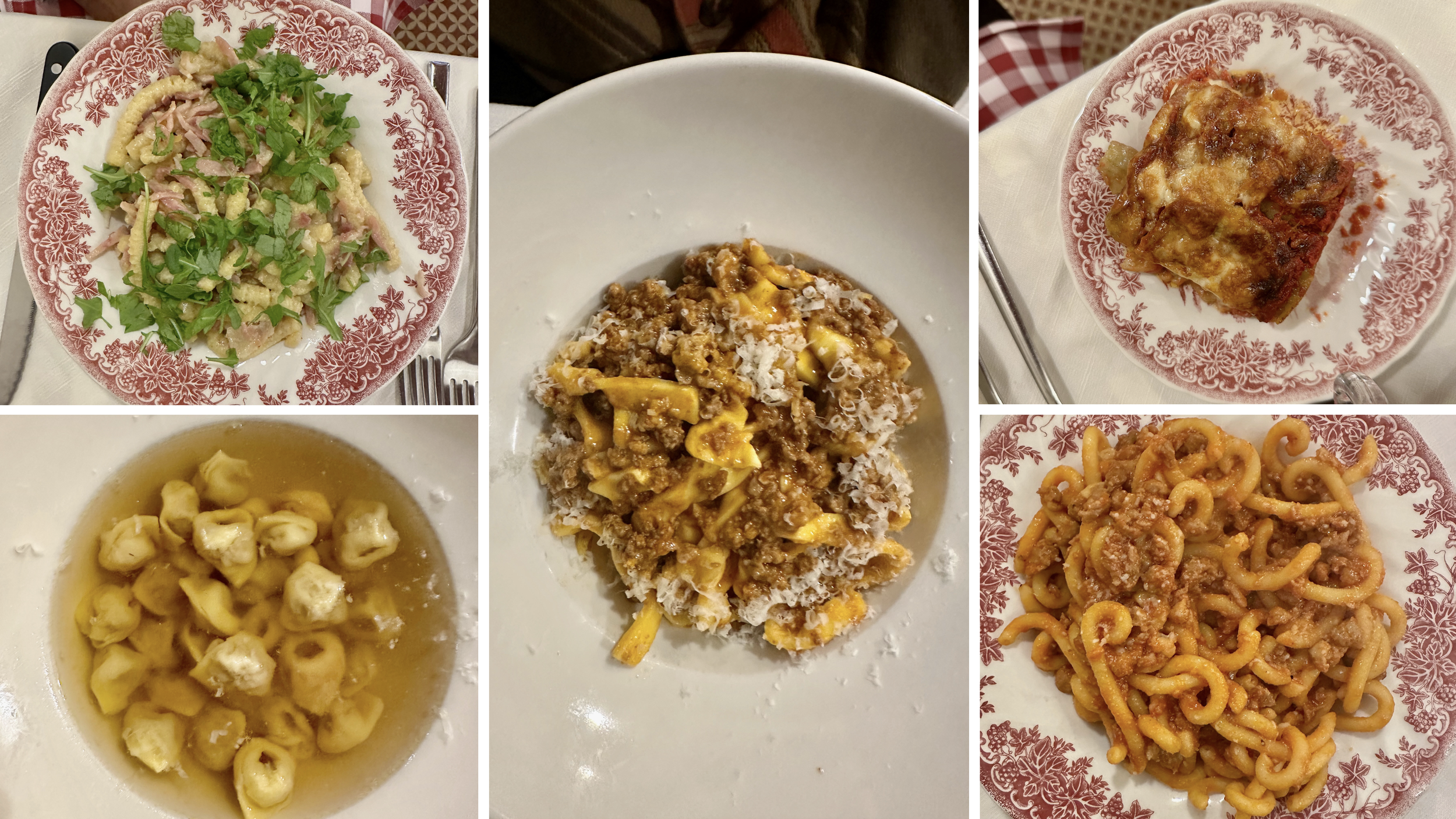
Bolognese cuisine is delicious but hearty and meat-heavy. Classics like tortellini, lasagna, and ragù are all rich with meat. The pasta contains eggs—a nod to the north’s wealthier past where eggs were added to flour and water—resulting in specialties like tortellini, ravioli, and tagliatelle. The region is famous for its Parmesan cheese, Sangiovese red wine, and balsamic vinegar. Pork is beloved. There’s a dish called Cotoletta (or Petroniana), essentially veal fried in butter, topped with prosciutto, smothered in Parmesan and meat broth—a literal heart-stopper. Hopefully, we’ll find ways to stay more plant-based here, but dining out in typical Bolognese trattorias might make that a challenge. Mamma mia…

These pasta dishes were delicious but probably did not “meat” the criteria of the EAT-Lancet Commission (Mio Dio!).

When we arrived, Bologna was hosting the “Villaggio contadino Coldiretti,” a fair spread across the city’s piazzas. Farmers from across Italy gathered to celebrate “the centrality of the agricultural world, sustainability, and the value of Italian food.” Coldiretti represents over 1.6 million Italian farmers and agricultural entrepreneurs, advocating fiercely for “Made in Italy” products. They lobby against lab-grown meat, expose agromafia issues, and protest unfair trade price speculation. Some argue these “village” events misuse public spaces and they have ties to the conservative right in the country. I suspect their views on the EAT-Lancet Commission wouldn’t be glowing either…


Walking the world away

There’s something beautifully liberating about walking. Sure, many people equate freedom with owning a car—the open road, the power to go wherever, whenever. But for me, real freedom looks a little different. It’s in the simplicity of walking. No baggage, no plan—just the steady rhythm of your steps and the openness of the world unfolding around you.

Sometimes there’s no destination, and that’s the point: just you, your thoughts, and the path ahead.

It’s something you can do anywhere—through city streets, across forest trails (what we often call hiking), or wandering the quiet edges of forgotten places. You’re never stuck in traffic. If you hit a barrier, you pivot. You reroute. You move on.

You never have to stop.

I’ve written before about the quiet art of flâneuring—that gentle wandering without aim, where the city reveals itself step by step. It’s a ritual my better half and I have embraced over the years, our own kind of moving meditation. Together, we’ve traced the grid of Manhattan in what we called the MaPhattan Project, roamed the worn cobbles of Rome’s rioni, meandered through Bologna’s shadowed porticoes, and covered miles of our Microcosmic Psychogeography of D.C.'s grand avenues and quiet corners. All past places of residence for us.

We walk and talk. We walk and listen, and sometimes, we walk and share bites of something warm and wrapped in paper. But always, we move forward—one foot, then the next—letting the rhythm of the road bring clarity, connection, and stillness in motion.

Food Archivist flaneuring in Meatpacking District NYC before it become douchebag central. Early naughts.

It’s one of the reasons we always found our way back to New York—the pull of the pavement, the hum of the streets beneath our feet. It is the sweeping equalizer (much like the subway) of the city in that everyone (just about) can do it - it doesn’t cost a cent. Once upon a time, Gotham belonged to the walkers. We moved through it like warriors, bold and unshaken, owning every crosswalk, every corner.

But something’s shifted.

Now the streets hum a different tune—faster, sharper, less forgiving. E-bikes flash past like ghosts, scooters weave through traffic with no regard, and cars ignore the rules like they were never written. Gotham, once ours, has become hostile to the quiet act of walking.

To step off the curb now is to take a risk—to scan left, then right, then left again, heart stuttering with every motion blurring past. But in the early mornings, when the city that never sleeps has yet to awake, one can silently flaneur.

Evidence suggests that walking has multiple health benefits. Walking briskly for 150 minutes a week can reduce risk of heart disease and overall mortality. That isn’t too hard. This NYT article summarizes some of the evidence. I try to get 150 min in and plus some every week. On average, at least according to my phone, I walk about 4.8 miles a day. I also try to walk each and every day no matter how busy I am. If you live far from work, maybe get off a train station further and walk the rest of the way. If you drive to work, maybe make a meeting a walking meeting. There are lots of ways to build it in throughout the busy days.

In a world moving towards utter chaos and disorder, walking remains a quiet act of rebellion—an invitation to slow down, to notice, to reconnect or maybe, to disconnect and put the world on pause. Step by step, it gives us back a sense of place, of presence, and of ourselves.