As the summer solstice nears, I feel the tug. The urge. The pressure to do things differently. Read 10 books! Swim every day! Have meeting-less workdays! I scheme in grandiose ways, convinced this will finally be my "summer of quiet," carefully crafting elaborate to-do lists (therein lies problem #1). I tell myself I’ll finally live and work on my own terms, freed from the weekly teaching schedules and the usual semester onslaught. Everyone else is on holiday, right? The emails will slow down…yes?
In one sense, it’s all true. But after fifty-four years on this grand planet, you’d think I would have learned by now. Summers come and go, just like the seasons and the years. And sometimes, they just aren't the summers of your life.
Back in August 2019, I wrote a blog entry titled "Su-Su-Summertime Sadness." In it, I confessed:
“My summers always haunt me. The could’ves, the should’ves, the would’ves. I could have done more with my summer, or I could have done less. I should have done what the Italians do and taken a whole month off to celebrate Ferragosto.”
I even put together a playlist to mark the end of the season, which only succeeded in draining the last of my ambition.

I mean, WTF.
I think this notion of “this is going to be the best summer ever” starts back in elementary school or junior high. Remember those days? Once you finished whatever house and yard chores your mom left for you, the rest of the summer was yours. You went swimming sans sunscreen until your hands were shriveled-up prunes (they were different times, my dear readers). You rode your bike with your amigos down to the 7-Eleven for a Smarties candy necklace, washed it down with a Slurpee, and played kickball into the depths of the night with the neighborhood kids until you couldn’t even see your hand in front of your face.
Total freedom.
We made our own lunches and were entirely on our own. No longer mandated to eat cafeteria school “lunches.” My personal favorite? Campbell’s Cream of Mushroom soup with Lays sour cream and onion potato chips crumbled on top. Variant B was Campbell’s Golden Mushroom soup, sprinkled with Ruffles cheddar-and-sour-cream potato chips. All of it was washed down with a Pepsi and finished off with a Ding Dong or a Ho Ho. Honestly, it is incredible that I am still alive…(don’t hate me Carlos Monteiro!). We were, after all, living that middle-class suburban American life (think 80s: ET, Poltergeist, Sixteen Candles, ya’ll).
I used to beat myself up for not being "productive" enough during the summer. But lately, as some of you know, I’ve been practicing “niksen.” It’s a Dutch term that means intentionally doing nothing without a purpose or a deadline—just gazing out the window, taking in the scenery, and letting your mind wander. The Italians, of course, have elevated this to an art form.
This art form is known as dolce far niente—the sweetness of doing nothing (Yes, it was popularized by Eat, Pray, Love, but let’s look past that, dear readers). Come summer, they take oziare (to laze about) quite literally. Most of the country shuts down for the entire month of August so everyone can head to the beach, the mountains, or all’estero (abroad) for some R&R. This whole phenomenon is called Ferragosto. Technically, it’s just one official holiday on August 15th. But in true Italian fashion, they looked at one day and thought, “Why not take the whole goddamn month?”
Perché no?
The tradition dates back to 18 BC with the Feriae Augusti, when Emperor Augustus declared a period of rest for agricultural workers. Fast forward a couple of millennia, and it’s still the best excuse on the planet to completely unplug.
I am still working on my niksen (or oziare) skillzzz, but I think I’m finally getting the hang of it. I also promised myself I’d travel less, and boy, have I delivered. One can rarely find Jess Fanzo at a conference anymore. I did make an exception to attend UN Nutrition Week in Rome. I genuinely enjoyed many of the sessions, but my god... the UN really needs to jazz it up. The format is stuck in the past: static panels, formal posturing, dry delivery, and zero audience interaction. The core content is incredibly important, but there has to be a better way to communicate global messages than having a row of people make disconnected, five-minute statements. The irony is that this meeting couldn't have come at a more crucial time. And there were so many fantastic experts in the room who understand deeply how to scale nutrition to the places where it is needed most. Nutrition is chronically underfunded, and global food crises are mounting. Rather than slipping into insular navel-gazing, this forum needs to expand. We need to invite more than just the usual UN crowd and build real, inclusive bridges across different sectors.
From Rome, we took a short trip to visit friends in Napoli—one of our absolute favorite places in Italy, even if the city is beautifully, brilliantly insane. The food alone is worth the chaos. As a pescetarian, Naples is pure heaven. The ultra-fresh mozzarella di bufala that practically weeps when you cut into it, bowls of spaghetti alle vongole packed with local clams, and my god, the wood-fired pizza.
But beneath all that incredible food and vibrant street life, there is a haunting uncertainty to Naples. You can't escape the looming presence of its geology. The entire region sits on a massive, restless volcanic system—from the ominous silhouette of Vesuvius to the steaming, sulfurous bradyseism of the Solfatara craters, constantly reminding you of the earthquakes bubbling just below the surface.
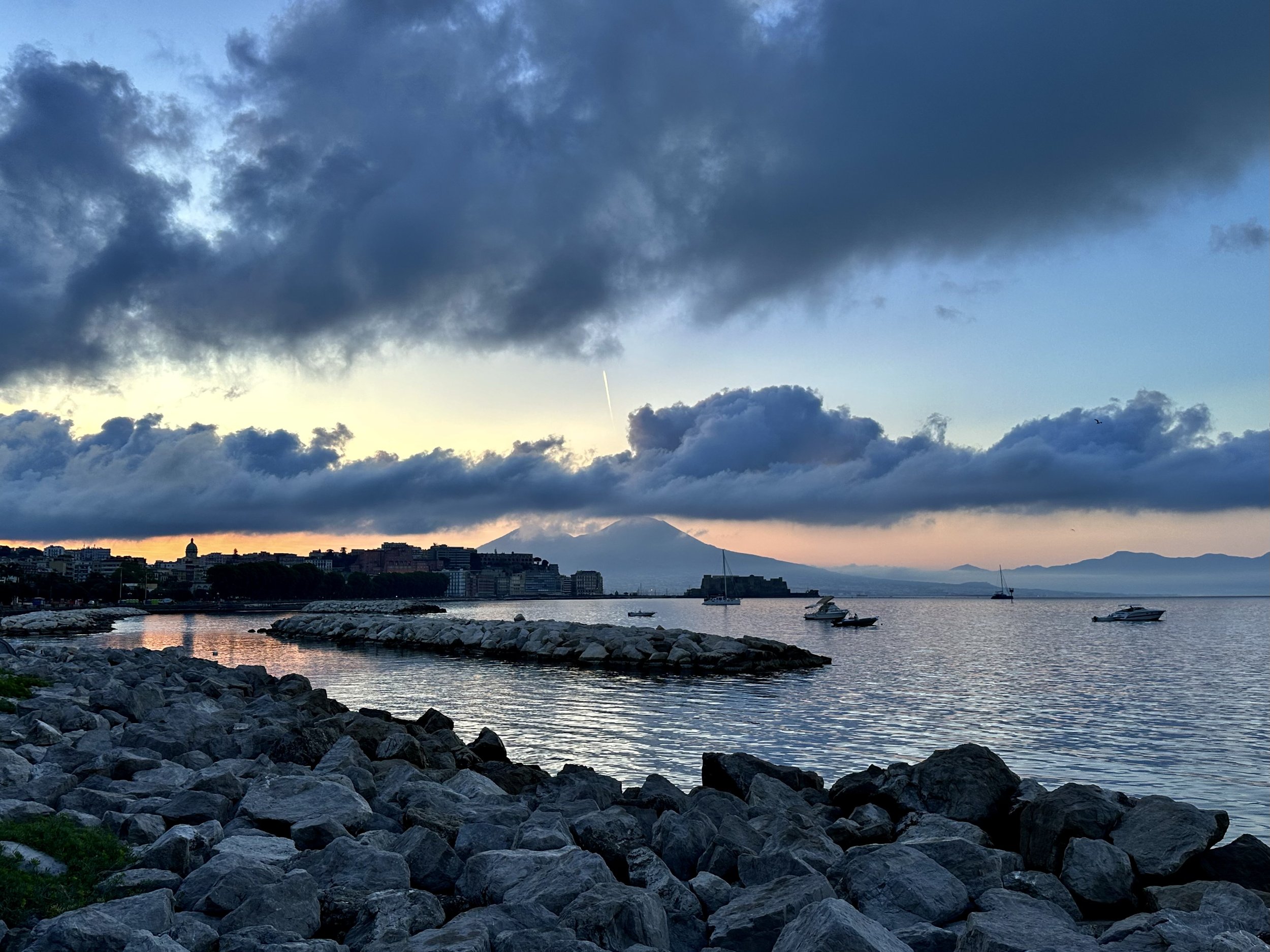
Vesuvius beckons…
While we were there, we watched the gorgeously shot Pompeii Under the Clouds. It’s a film that somehow does nothing but everything all at once—capturing the beautiful, eerie reality of a defiant city that lives, eats, and thrives completely in the shadow of a ticking clock.
..So, remember that ironclad promise I just mentioned about traveling less? Well, the rest of this summer will feature a quick trip to Brighton—to see our good buddy Lawrence Haddad and his family—followed by an Annual Review of Nutrition editorial meeting in London. Then, it's off to Kraków and Warsaw, Poland, for the 10th Annual Conference on Agricultural Statistics. And this year, for the first time, I am actually using up my Ferragosto card — we will spend all of August in Napoli caring for our friends’ place (with a f*#* off view), visiting the islands, amongst the rumbles. And come fall? I am jetting off to much farther-flung places, including Ethiopia and Indonesia. I swear I am still practicing my niksen... I might just have to do it from an airplane seat.
All of these reflections, contradictions, and journeys just leave me thinking about how incredibly lucky I am, how lucky many of us are. And how many of us are not. It is so easy, so privileged for me to say this, right? Particularly in a time when there is so much darkness, so much hate, so much strife in the world. The United States. Gaza, Lebanon, Iran. Sudan. Ethiopia. Ebola. Epstein. The list goes on and on. I recently came across a beautiful piece in The Atlantic written by Alan Lightman, titled "The Ordinary Miracle of Existing." He captures this exact feeling of existential gratitude perfectly:
“Just as our entire planet is a speck in the cosmos, our individual lives are fleeting moments in the grand unfolding of time. And, as the Buddhists always emphasize, everything is impermanent. Everything passes away. The ancient cities of Sumeria and Egypt are long gone, as are the temples of ancient Greece and Rome. Tenochtitlán, the capital of the Aztec empire; Port Royal of Jamaica; the English coastal village of Dunwich. All gone. All that we see around us today will one day be gone. Against this backdrop of history, on Earth and in the cosmos, our individual lives are brief flickers in the chasms of time. It is hard to imagine such a cavernous theater we find ourselves in. But it is even more difficult to fathom how unique each of us is, how improbable, how lucky to be alive at all.”
Striking, isn't it? Especially when you consider how much we try to pack into our brief flickers of summers, of seasons, of well, years. He goes on to note:
“Little by little, we humans gain an understanding of what the world contains. We socialize, we read, we travel, we experience. But, in hindsight, our perspective remains highly limited.”
What the world contains. What the world contains is ultimately a mirror of how we choose to move through it. It forces us to ask: how do we want to live the days we are given? When we realize how small our vantage point truly is, the pressure to "do it all" gives way to a deeper desire to simply live well. It's a humbling reminder as we all head into this summer solstice. We explore as much as we can, we chase the perfect summer, and we try to find moments to simply be. Our perspective is only ever a tiny slice of a massive, beautiful picture—but how lucky we are to get to see it at all.
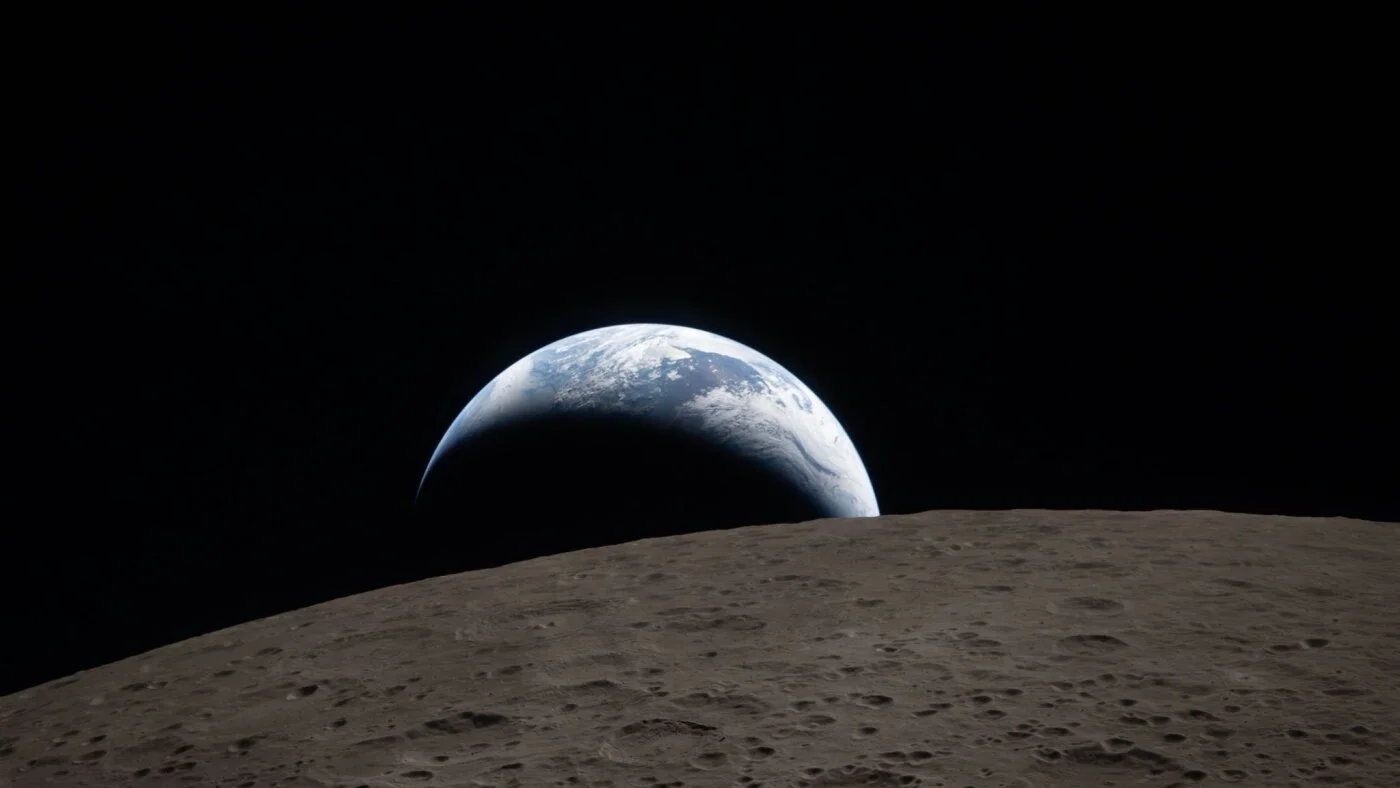
Earthset captured through the Orion spacecraft window at 6:41 p.m. ET on April 6 during the Artemis II crew's flyby of the moon.