We’ve spent most of late October and November in Italy, preparing for our permanent move to Bologna. Being away from the United States has been refreshing — I catch up on the news less often and with far less emotion. From afar, everything seems a bit bonkers. For anyone feeling overwhelmed by it all, and who has the chance to travel outside the U.S., I highly recommend it. It offers a powerful perspective.
The CFS plenaries largely empty.
Our journey began in Rome with a meeting at the Food and Agriculture Organization, whose building now feels almost impenetrable. I attended the Committee on Food Security (CFS), which was eerily quiet. The current Director General of FAO seems to have shifted focus away from the CFS, scheduling World Food Day a week earlier—a move that, frankly, deflates the committee’s momentum. The sessions were muted, with scant government presence. Even the plenaries were only a quarter full.
Perhaps multilateral cooperation and globalism are truly fading, as Richard Horton recently suggested here and here. We’ll see how the world responds at COP30 in Brazil, tackling the urgent challenge of climate change. Sadly, I agree with a recent New York Times article arguing that governments—not just the U.S.—are turning their backs on climate commitments. There are isolated successes, but the overall climate data is grim. The UN’s annual emissions gap report, “Off Target,” warns that countries are unlikely to keep global warming below 1.5 degrees Celsius, the Paris Agreement’s main goal. Experts predict warming could reach between 2.3 and 2.5 degrees Celsius, or even higher if current pledges aren’t met.
Long lines at Da Enzo
Back to Bella Italia. My partner and I have spent nearly five cumulative years living in Rome. When we first arrived in 2010, those felt like golden years. Tourism was present but manageable, with many hidden gems for eating, drinking, and soaking in the vast cityscape. Today, forget it. Rome has turned into a theme park resembling a mockable Roman empire, swarming with tourists. Even secret spots are overrun by huge lines of people eager to replicate the Instagrammable moments. Our favorite place, Da Enzo, now has block-long lines. We used to pop in spontaneously for carbonara and puntarella. It’s sad—Rome and much of Italy have sold themselves cheaply, like a dollar store bonanza.
After Rome’s disappointment, we went to Napoli to visit friends. The city, too, is suffocating under endless tourists—around 5,000 daily from massive cruise ships—who come to eat pizza, drink spritzes (a drink actually invented in Veneto, northern Italy), and walk the “elephant walk” through Spaccanapoli buying cornicelli charms (little horn-shaped amulets for good luck), all because social media told them to. They don’t really experience the city or stay overnight, retreating to their ships for dinner and sleep. Locals believe tourism boosts the economy, and it probably does—but at what cultural cost? Is this growth sustainable? Naples, too, has given itself away. The New York Times article, “The Spritzes and Carbonaras That Ate Italy,” argues tourism has blanketed the country in a uniform food culture. Maybe not everywhere, but it’s heading that way. Nothing can take away the beauty of these places, but god damn, it is getting hard to see it.
Naples wasn’t all bad, once you are off the beaten path. Walks along and swims in the bay of Naples, insanely delicious pizza and vongole, and a lecture at the University of Naples Federico II Agriculture College were highlights. The College is in a beautiful old royal palace in another part of Naples, called Portici. The palace was built as a summer house for the Spanish viceroys on the slopes of Mount Vesuvius. The college curates a beautiful botanical garden on its grounds. The students and faculty were truly wonderful — they energized me to start teaching this spring in Bologna.
Typical aperitivo for two - and costing less than 8 euros…
From Naples, we took the train north to Bologna, and suddenly it felt dramatically calmer—fewer tourists, more progressive energy. The “Quadrilatero” district, a historic medieval market full of gourmet shops near the main piazza, was surprisingly uncrowded. Bologna is a beautiful city bathed in warm orange and yellow hues, with miles of elegant porticos offering sheltered promenades. The city pulses with the energy of its students—the University of Bologna is Europe’s oldest university. Street art decorates many corners, and the local “aperitivo” culture thrives. Bolognese gather around 6 p.m. for wine, cocktails, and small free snacks (why do potato chips taste so good with sparkling white wine - drats!), with weekends seeing aperitivo start even earlier.
There are downsides. The weather is more like NY, and the air quality ain’t good. But it feels like a progressive, productive city that has a certain gothy, young vibe. Will we be able to sit out on our terrace 365 days a year, ala Rome? No. But would I take this over the tourism hellscape? Hells yah.
Bolognese cuisine is delicious but hearty and meat-heavy. Classics like tortellini, lasagna, and ragù are all rich with meat. The pasta contains eggs—a nod to the north’s wealthier past where eggs were added to flour and water—resulting in specialties like tortellini, ravioli, and tagliatelle. The region is famous for its Parmesan cheese, Sangiovese red wine, and balsamic vinegar. Pork is beloved. There’s a dish called Cotoletta (or Petroniana), essentially veal fried in butter, topped with prosciutto, smothered in Parmesan and meat broth—a literal heart-stopper. Hopefully, we’ll find ways to stay more plant-based here, but dining out in typical Bolognese trattorias might make that a challenge. Mamma mia…
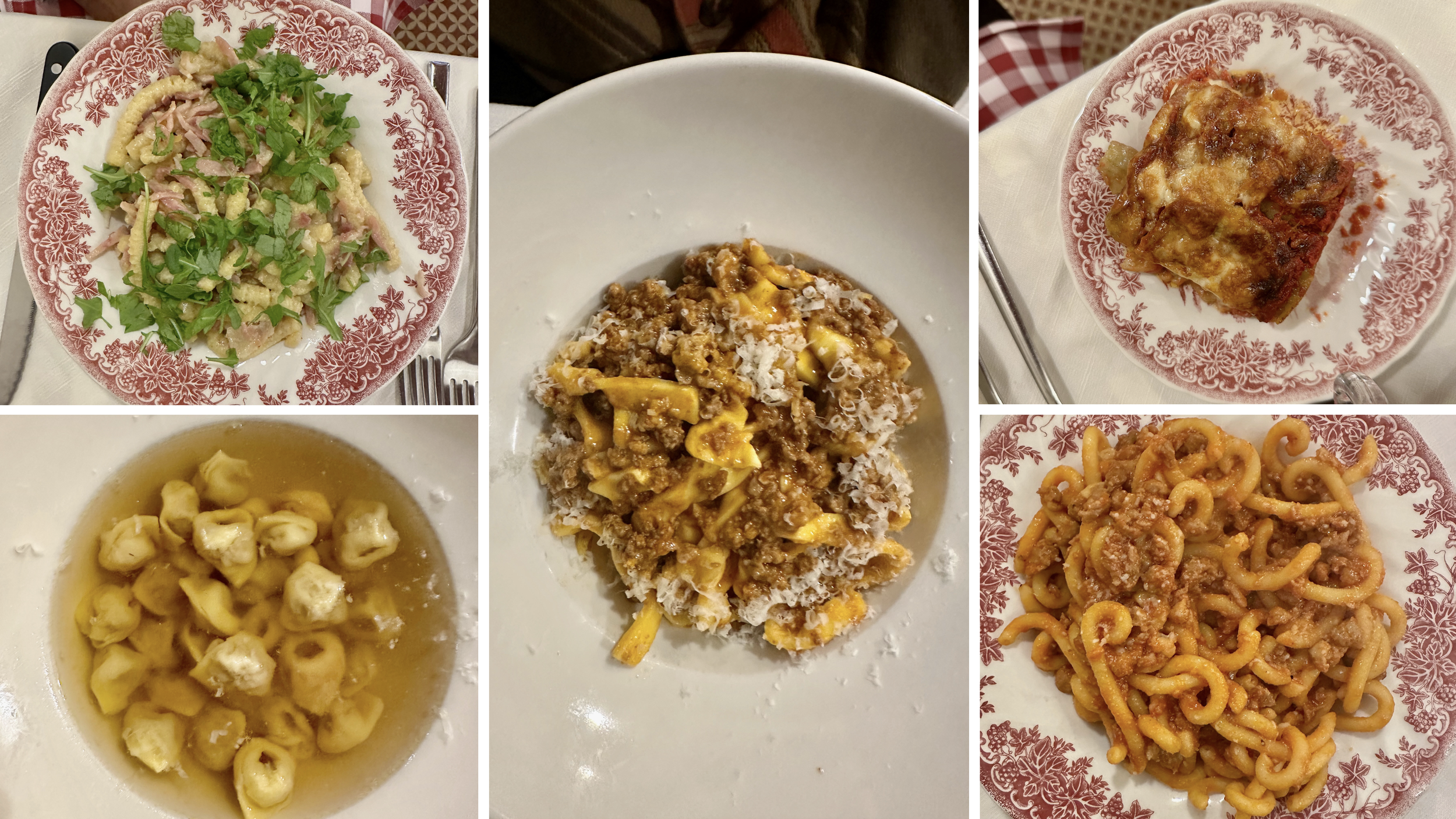
These pasta dishes were delicious but probably did not “meat” the criteria of the EAT-Lancet Commission (Mio Dio!).
When we arrived, Bologna was hosting the “Villaggio contadino Coldiretti,” a fair spread across the city’s piazzas. Farmers from across Italy gathered to celebrate “the centrality of the agricultural world, sustainability, and the value of Italian food.” Coldiretti represents over 1.6 million Italian farmers and agricultural entrepreneurs, advocating fiercely for “Made in Italy” products. They lobby against lab-grown meat, expose agromafia issues, and protest unfair trade price speculation. Some argue these “village” events misuse public spaces and they have ties to the conservative right in the country. I suspect their views on the EAT-Lancet Commission wouldn’t be glowing either…