FOOD BYTES IS A (ALMOST) MONTHLY BLOG POST OF “NIBBLES” Serving up the science, policy, and cultural facets across CLIMATE change, FOOD systems, & NUTRITION.
It’s been a while since I wrote a Food Bytes post. They take a lot out of me because so much comes across our desks via social media, traditional media, scientific papers, and reports. Sometimes, it is just too much to take in. Sifting through what may be worth highlighting can be a pretty random process, and developing a flow from one thing to another can often be challenging. Anyways, here it goes!
The most obvious place to start is with the war in Iran. What a costly and tragic mess the U.S. administration has made. Now, as many experts have described, the world may be facing a deepening food crisis due to fertilizer, feed, and food not moving through the Middle East, and lots of market speculation on fuel and food prices. If this conflict continues, the effects will be devastating for farmers around the world and the most food-insecure. Some peer-reviewed articles are already getting published that analyze and discuss the impacts on food security, such as here and here. Major media outlets are reporting on it too; here are two interesting reads from The Economist and The Financial Times. Bloomberg News is discussing how crude oil prices are affecting other oil products, particularly biofuels.
Extreme heat impacts on agriculture, FAO and WMO report (2026)
This also comes at a time when there is (again) much discussion about how food is being used as a weapon of war. I was particularly intrigued by this article from the Council on Foreign Relations, which includes embedded videos from experts around the globe. Speaking of geopolitical impacts on food security, Marc Bellemare, Bernhard Dalheimer, and Weston Loughmiller have an informative working paper out on this timely topic. In the Eat This Podcast with Jeremy Cherfas, they argue that agricultural economists have not paid enough attention to what they call “neglecting security externalities.” I am sure this will kick up some conversations. To make matters worse, the just-released 2026 Global Report on Food Crises reports that 266 million people experienced high levels of acute food insecurity in 2025 and Famine (IPC Phase 5) was confirmed in two countries/territories the same year – in parts of the Gaza Strip (Palestine) and the Sudan –a first since IPC reporting began. Now the world is closely watching South Sudan as well.
Things may not bode well for the many farmers who toil day in and day out to bring us the diverse foods traded around the world. The new FAO and WMO joint report, Extreme Heat and Agriculture, argues that extreme heat is driving massive losses in agricultural productivity. Already, maize and wheat yields have declined 7.5% and 6%, respectively, with 1 °C warming. They provide a clear framework of how this is happening across both direct and indirect pathways (see the figure to the right). And now, meteorologists are predicting a potentially strong El Niño (or as this author calls it, the fourth horseman of this foodpocalypse), which could leave some parts of the world hotter and drier.
On climate + food, some other reports and papers that may be worth a read:
A paper in Nature Food shows that in order to sustain yields of wheat, maize, rice, and barley production under 1.5 °C (current and unattainable climate target) and 3 °C warming (business as usual) scenarios, the world will need 13% (25 Mha) and 47% (94 Mha) global irrigation expansion, respectively. Yowza. Yes, we should be worried, but the question is, why aren’t we?
A review paper in Nature Reviews: Earth and Environment on the “Broad bidirectional effects of global food production on the environment” got some airtime. It is a nice summary, but nothing really new that the EAT-Lancet Commission and others have not extensively written about. And while they list a series of solutions, I always find them a bit vague…who, how, when, why, and for whom seem to be missing in these laundry lists of actions. Maybe I am just getting grumpy in my old age…
This paper in PLOS Climate claims meat and dairy companies spend a lotta time greenwashing. Gee, what a shocker! In all seriousness, this stuff is just infuriating, and papers calling out this behavior are super important. Keep it up guys!
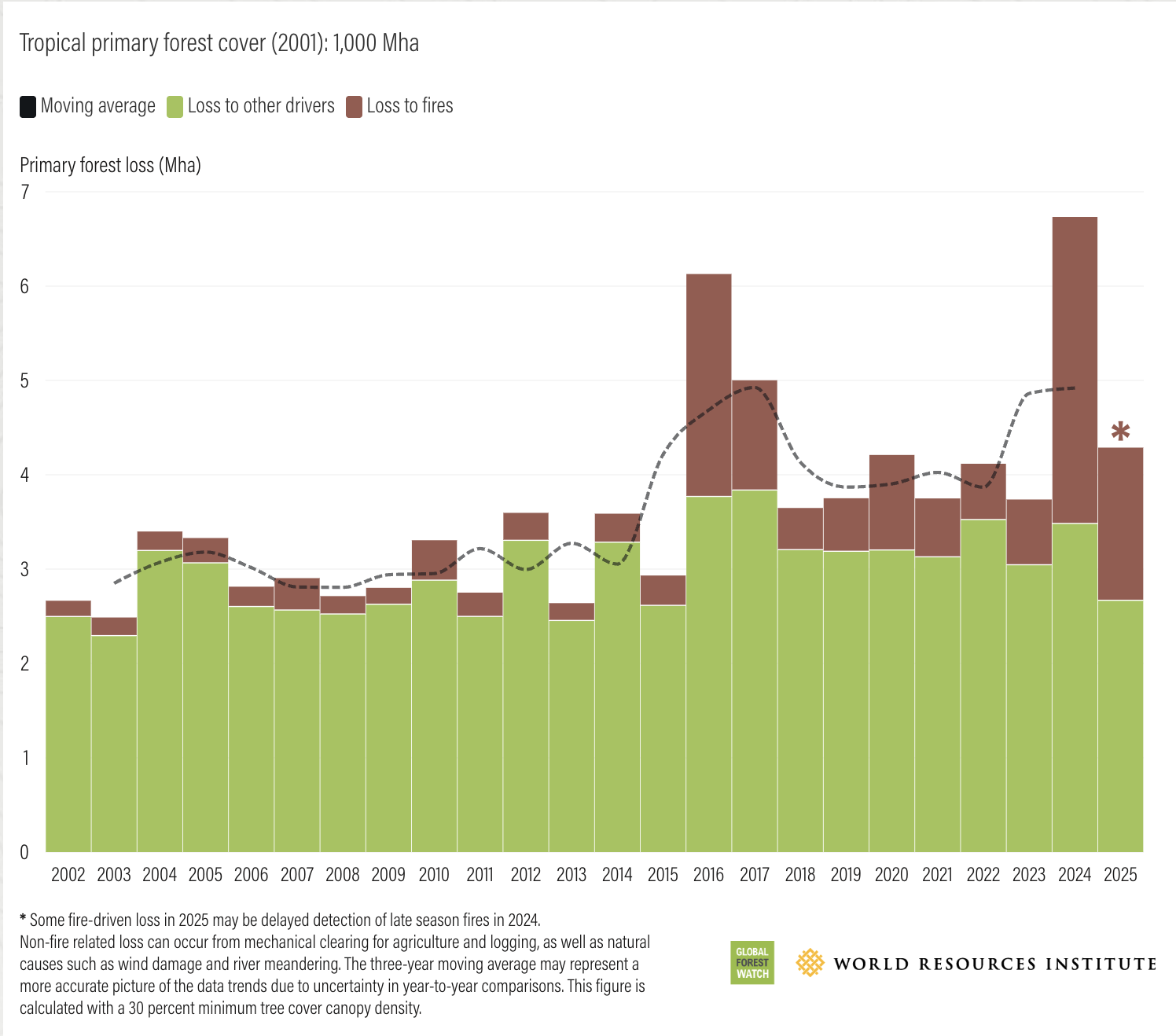
On a more uplifting note, the World Resources Institute, in collaboration with the University of Maryland, reports that tropical primary forest loss decreased by 36% from 2024 to 2025, following a record-breaking year of extreme fires. Yay! Something positive in the world! Check out the tracking on the right, which shows we are back to where we were in 2023.
On diets + food security, we have some goodies that have been published in mainstream media and peer-reviewed. Here is a recap:
I am a big fan of Kibrom Sibhatu. He and others just published a paper examining the impacts of development projects on dietary diversity and food security in 24 low and middle-income countries. What did they find? Not much changed for dietary diversity, but food security improved (almost 8%). Unfortunate, as all eyes are on the future of, and the impact of, the decades of investment in international development…
The great Carlo Cafiero has spent decades at FAO, spearheading food security metrics such as the POU and the FIES. He is retiring soon (will the organization cease to exist thereafter?), and here are his insights, lessons, and reflections after many years spent toiling to measure food security. Worth a read.
Several of us published a review paper in Science describing how global food systems, along with rising incomes, urbanization, and the growth of ultra-processed foods, have driven dietary shifts that harm human health, the environment, and equity. We synthesize evidence across seven intervention domains to steer dietary transitions toward outcomes that are healthier, more sustainable, and more equitable. Key levers are highlighted, including R&D and product innovation to make plant-forward, sustainable foods tastier and cheaper; affordability and access measures, such as redesigned food assistance and supply-chain policies that internalize health and environmental costs; and food-as-medicine programs that embed nutrition into healthcare. There are also regulatory approaches — including reformulation targets, labeling, marketing restrictions, and public procurement standards — that are essential complements to voluntary actions, because nudges aimed only at individuals or producers are often overwhelmed by institutional food-environment influences.
The Atlantic put out a piece on how the “whole grain trend went wrong.” Did it ever go right?
Speaking of stellar food, the NYT published an article on how omakase sushi has become so popular in cities like New York, to its detriment. I particularly liked this passage: “In classic omakase, a chef has leeway to improvise in the moment, modulate, maybe even figure out what kind of person you are. These days in New York, the experience is more often one-size-fits-all: a fixed series of courses — essentially, a tasting menu — ranging from a dozen to 20 or more, with accommodations only for allergies or a particularly querulous diner, and often not even then. At the highest-end spots, everyone sits down at the same time and is fed in the same order, as if at the most elegant of mess halls.” And this: “With each bite, I had the nagging sense I was being spoon-fed, like a finicky child who couldn’t possibly know what’s really good or keep an open mind. There was nothing funky or chewy that might demand a pause to wonder: What am I eating?” Every time I go to omakase, I feel like an overstuffed cow eating at a trough waiting for my owner to shovel out a few measly morsels.
And just to rub some USDA-approved, low-sodium salt substitute into the festering wounds left behind by the latest release of the U.S. dietary guidelines (aka RFK Jr’s personal diet), welcome to the “crunchy” teens who serve as wellness influencers. Someone, please, just shoot me. Maybe you don’t even need to read the damn article. Just look at the photos/videos of these teens wolfing down red meat. I leave you with this quote, which just about says it all: “Ava Noe, a teenager based in the Boston area, has amassed more than 25,000 Instagram followers while criticizing ultra-processed foods and promoting colostrum supplements, mouth tape (WTF is this?), and beef tallow.” Yes, all you nutrition scientists out there, you are once again, totally irrelevant.
But maybe we don’t need to worry about beef-eating teens or IV-drip-fed sushi. Or, better yet, maybe we don’t even need to eat food at all anymore, because everyone seems to be getting their hands on GLP-1 inhibitors and self-experimenting with doses, how long they stay on them, and which symptoms and ailments they target. Has food and the food system become, shall I say, immaterial? As Tears for Fears sang, it’s a mad world. God damn right.
AI is not going anywhere soon. Some are for, some are against. In this paper in Nature Food, the authors argue that its impacts “depend on how institutions choose to design the infrastructures, competences and incentives that surround it.” Not really sure what that means to be honest… IPES published a report entitled "Head in the Cloud" that raises concerns (naturally!) about AI technology and other high-tech innovations to digitize farming, which they argue are largely controlled by a handful of major tech and agribusiness firms, creating farmer dependency and high production costs. It is an interesting read on the perils of technology that need to be governed and balanced with people-centered policies.
Speaking of technology, this group argues that ultra-processed foods are driving the plethora of plastic in our global food systems. Can’t wait to see some data around this claim, but I am sure Joe Yates and others are building a strong case! I guess the next thing we need to wonder is, how the hell are we going to extract ourselves from all this plastic? Good thing Dustin Hoffman’s character in The Graduate, Benjamin Braddock, shrugged at the prospects of working in “PLASTICS.” There is hope!
Well, that’s it for this month, folks. I will leave you with this little ditty by one of my favs, Jessica Pratt, called Mountain’r Lower. Seems like a song that is giving the spring season a chance. See you in June!