This publication, Combating converging crises: The role of universities in global health, climate, and equity, stemmed from a Bellagio Rockefeller convening that we authors participated in—which, as it happened, took place right during the 2024 US election when Donald Trump won. Witnessing that massive political shift in real-time heavily underscored the urgent premise of our paper: universities are currently facing a perfect storm of intense political polarization, funding cuts, and escalating climate-driven health risks like extreme heat, infectious diseases, and widening social gaps. In a world increasingly crowded with misinformation and scientific denialism, academic institutions cannot afford to be passive observers. They must actively step up to defend objective truth and champion public solutions where climate, health, and equity collide.
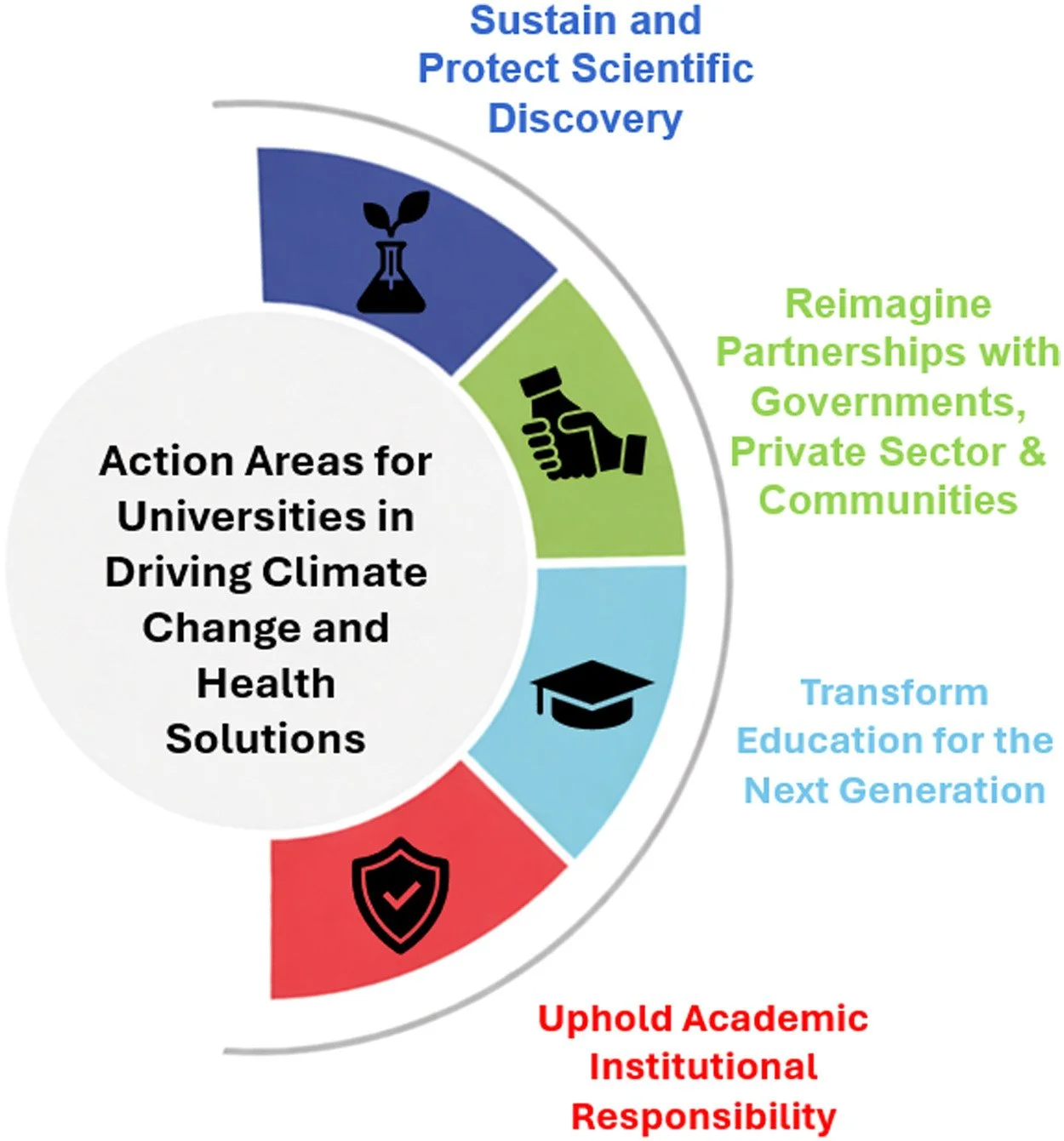
To guide institutions through these turbulent times, our piece outlines four interlinked responsibilities for the modern university. First, they must fiercely safeguard scientific discovery and act as a public shield against misinformation. Second, to weather unpredictable political and financial shifts, they need to diversify their funding by building deeper, more resilient partnerships with local communities, industries, and governments. Third, they must practice what they preach by taking institutional responsibility for their own environmental footprints, actively cutting their own greenhouse gas emissions while maintaining rigorous ethical standards. Finally, they need to completely overhaul education, breaking down old academic silos to arm the next generation of leaders with the cross-disciplinary skills required to solve real-world crises.
Ultimately, these recommendations offer a practical survival guide and call to action for higher education during deeply fragile political moments. By shifting away from isolated ivory towers and transforming into dynamic, collaborative engines of change, universities can maintain their status as trusted, evidence-based spaces for global cooperation. For communities navigating the future of our health, environment, and food systems, this perspective serves as a timely reminder that tackling tomorrow's overlapping crises requires a bold, united, and socially responsible academic ecosystem.