In our latest paper published in the Advances in Nutrition, we explore the complex challenge of translating scientific evidence into practical policies and practices at the intersection of climate, food, and health.
We present a conceptual framework that underscores the interconnectedness of these domains and propose five core principles essential for effective translation: (1) integration of diverse disciplinary evidence; (2) early and sustained collaboration with policymakers and impacted communities; (3) context-specific application of evidence; (4) systematic identification of tradeoffs and conflicts of interest; and (5) strategic communication to align knowledge with action. These principles serve as a guide for researchers and practitioners aiming to develop resilient, equitable, and sustainable food systems informed by scientific evidence.
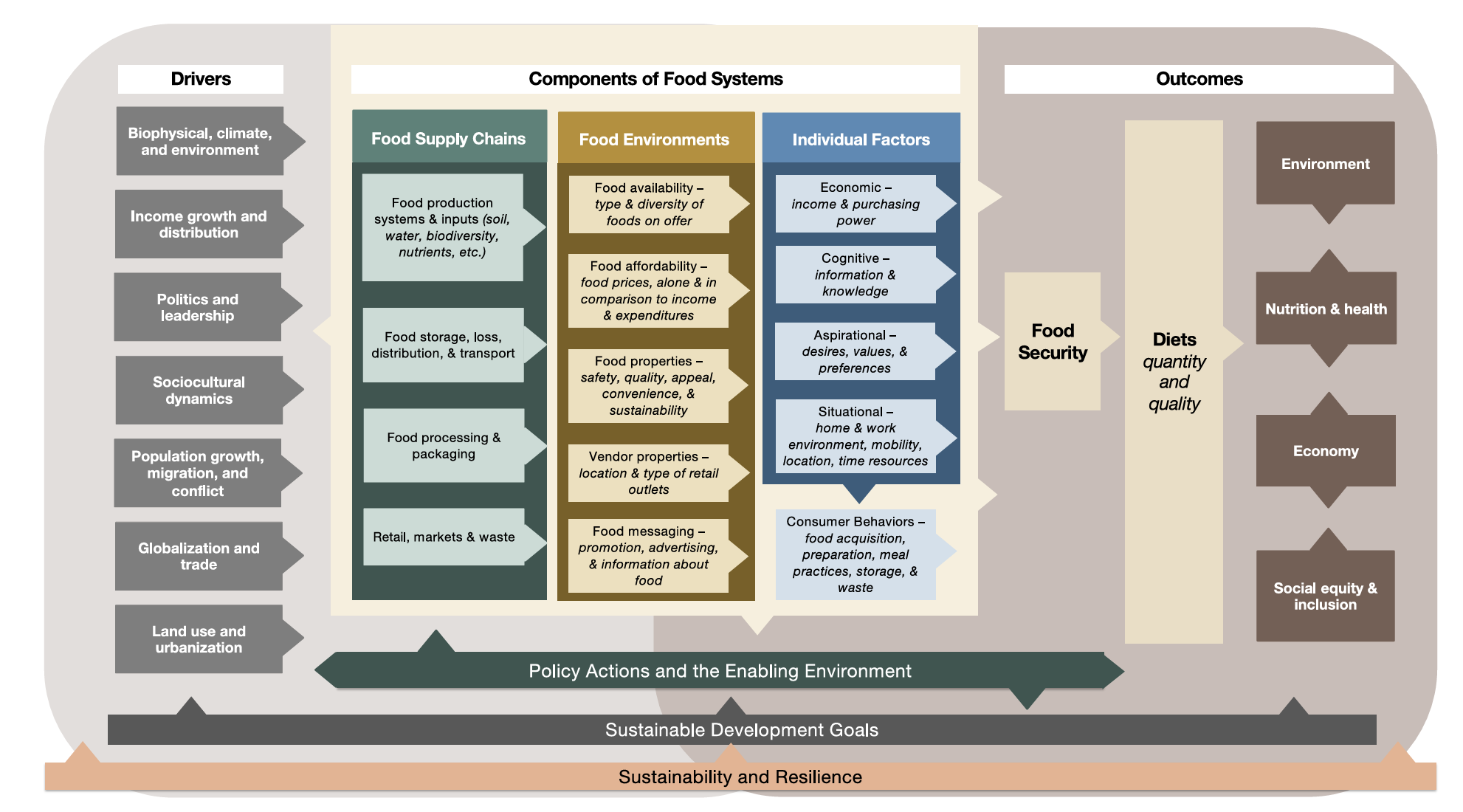
The complex and dynamic food system
To illustrate these principles, we analyze five case studies that demonstrate successful applications within different contexts. We highlight the California school food policy case, which successfully eliminated sugar-sweetened beverages and energy-dense snacks, serving as a national model for addressing food system inequities and environmental impacts. The Voluntary Guidelines on Food Systems and Nutrition represent a global collaborative effort that responds to local and national complexities, showcasing the need for stakeholder alignment in policy formulation. Additionally, we examine the State of Washington's initiative to establish metrics for assessing food system progress, which showcases effective collaboration between academia and government, while the dietary carbon footprint case emphasizes the role of individual dietary choices in influencing policy.
Our analysis also includes a New York City initiative, which integrates environmental sustainability into food procurement standards. This case demonstrates the importance of collaboration across different governmental administrations and public health departments. Together, these examples not only highlight the practical application of our proposed principles but also underline the importance of adaptive governance and innovative approaches in advancing food systems that are responsive to health and environmental challenges.
Overall, we advocate for a shift in how scientific translation is approached, encouraging a transdisciplinary approach to research that emphasizes collaborative effort, adaptability, and the recognition of various contextual factors that impact policy effectiveness at multiple scales.